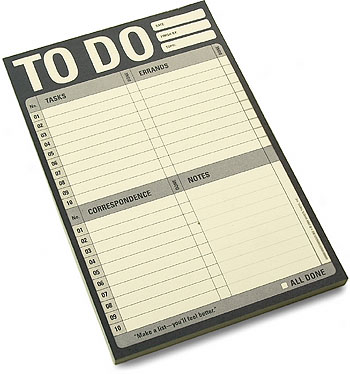
Sunday evening arrives and clearly a weekends worth of activity has passed and now the psychological transformation to next week starts taking place. Thoughts of all the appointments, meetings, and ‘to do’ come bubbling-up. A bit of overwhelm seeps into what had been tranquil calm and now I find myself a wave of anxious energy racing towards the Monday seawall.
Solution- I take my pen and paper and jot down everything I can think of. This is half an exercise in capturing actual actions and half journeying. It all goes down on the list. On Monday morning I look at the lengthy list and start to prioritize. Using a code of my own design I separate the list into categories. Anything I can accomplish in less than three minutes gets one mark, business related, family, fitness & health, community, personal finance, etc. No everything gets categorized but the big items are collected into buckets. My week now seems to have clarity and I can make schedule time to work on each category.
The lack of planning is why many nonprofit organizations like a fully developed committee structure. It give the board an immediate place to assign a ‘to do’ or new action. However, not many Boards sit down and make their Sunday evening list first. They just take what comes at them as assigned or they start making busy work for themselves. The strategic plan (or compliance issues) should be guiding your committee’s work. If they are not then you might wonder if your organization is using the talents of the committee members most effectively and to the highest purpose.
The best committees I serve on typically are the of task force variety. They have a definitive purpose and deadline. Some nonprofit organizations adopt a ‘no standing’ (permanent) committees structure. Board Governance and Finance Committees are usually standing committees for every organization. Each year the Board assemble the best teams to meet the priorities of the organization.
A blank piece of paper can be an effective planning tool.
 What-if-concepts