I stopped watching CNBC a couple months ago because I was no longer connecting with the content (plus bad news on a daily basis is never fun). I came across an article this morning that made me wonder why so many other viewers had abandoned the network over the past year. John Carney outlines a couple theories. The article is a reminder of how quickly an enterprise can be impacted by events and the speed, sincerity, and effectiveness in which your organization addresses the issue is critical. Anecdotal evidence from other consultants suggests that it takes at least 18-24 months before an organization can begin to recover its reputation after a scandal or major incident.
Author: whatifconcepts
What Segment of the World are you Serving?
Amazing talk, remarkable free website that will change the way you look at the world, and ideas that are worth considering no matter what problem you are trying to solve.
Annual or Limited Engagement
 Have nonprofit organizations trained donors to think that their donation one year will make perpetual change in the organization regardless if they give again. Said differently, if I donate $100 this year do I feel that the organization will be better off today and the next year and the year after if I do nothing else? I fall into this trap, feeling like I have made a donation last year so I can skip a year of support and get back to the organization at a later date. I know that my previous contribution has been spent and its benefits realized. Perhaps the impact of the gift had an extended half-life but the reality is the organization most likely has a cash flow requirement and much of it is predicated on the assumption that a series of donors will repeat their habit of giving on an annual basis.
So what if I am not ready for the commitment or need a different way of funding an organization or project. Perhaps a limited engagement is a better option. The following article in the NY Times caught my eye today since it is all about funding installations that are temporary in nature and design.
http://www.nytimes.com/2009/08/25/technology/start-ups/25kick.html
Are we communicating clearly with our donors and supporters? Are we providing the right opportunities for their funding?
Crowdsourcing
 Additional thoughts from yesterday’s blog, I came across more information about crowdsourcing. Two interesting links, one an article highlighting the creation of the online game Super Structure and the second is a link to the actual game website. The game requires numerous participants and relies on crowdsourcing to achieve the objective of saving the world.
http://discovermagazine.com/2008/sep/05-forecasting-the-future-may-be-a-matter-of-fun-and-games
http://www.superstructgame.org/
What are the advantages of the crowdsourcing? How could it support your planning and decision-making efforts?
CrowdSourcing and Game Forecasting
 I have been spending some time reading and thinking about game forecasting and crowdsourcing (see 8/17 post). This was all triggered by an article in the Sunday New York Times magazine last weekend. The article highlighted the work of Bruce Bueno de Mesquita and his method of using a proprietorial software program to uncover potential outcomes to global questions. http://www.nytimes.com/2009/08/16/magazine/16Bruce-t.html
I have been pondering the impact of this technology on the nonprofit and social sector. Clearly these fields have their own unique global questions. Donors are constantly trying to help move forward specific initiatives. Partnerships are formed. Movements dissolve. Do a few individuals control the fate of a cause or is it the will of the masses?
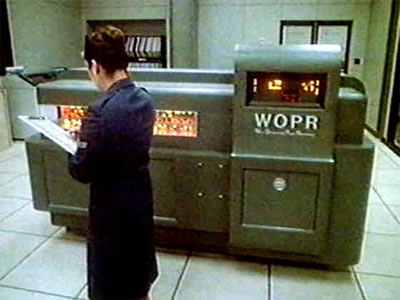
The 1983 drama-adventure film WarGames exhibited the futuristic WOPR supercomputer. The mainframe churned away on possible outcomes to nuclear war all the while undeterred by human attempts to over-ride its program. Although a Hollywood version of artificial intelligence, the movie highlighted the possibilities of game forecasting. The questions I ponder is the role this technology and method on the nonprofit sector. Will potential capital campaigns no longer use feasibility studies but rather turn to a software program to generate a numerical probability of success? Will future partnerships and mergers have to demonstrate viability via game forecasting before the respective boards will proceed? Will strategic plans retreats be run online in much the same way the television studio audience votes for their favorite clip on America’s Favorite Home Videos? Are we headed for a new level of sophistication or potentially a different master?
Mistakes Were Made
 My kids occasionally watch a Nick cartoon TV program, “The Penguins Madagascar.” In one episode the penguins believe they have traveled to the moon only to find out at the end of the show that they only flew in a rocket to the top of an adjacent building and then back to their enclosure at the Central Park Zoo. When the penguins question one another about the failed mission, one replies, “I forgot to carry the two.”
Yesterday, I incorrectly tweeted that Four Seasons Hotels use Twitter effectively and Hyatt Hotels does not. I ‘follow’ both Four Seasons and Hyatt on Twitter. I receive numerous daily updates from the Four Seasons but none from what appears to be the official Hyatt profile. Best I have learned, Hyatt leaves it up to each property to set-up and maintain their own Twitter profile. Since I am staying at one of their properties this week (one of my favorite) I immediately began following the particular property on Twitter. There is a lot of useful information and specials posted.
Four Seasons has the same arrangement where each property sets-up a Twitter profile. In addition they uses their corporate profile of @Four_Seasons to share information about each property and tweet about the company in general.
It is a complicated decision. Does the ‘brand’ maintain the relationship with the customer or is it the individual properties? Or does some hybrid method work better? I patronize both companies but more often Hyatt for a variety of reasons. There are particular properties that I am especially fond of and will follow on Twitter. As a frequent guest I also wonder how I should keep undated with specials and events at properties that I may not follow. On the other hand, there are days when I feel like the I heard enough from the Four Seasons because none of the tweets peak my interest.
So I apologize to Hyatt for my incorrect tweet. I wonder who you follow on Twitter? Why? What makes them worth following? What is effective tweeting?
If You Felt Like You Were Going In Circles
 You knew it was true, the feeling that you were going in circles. Turns out we are all prone to re-trace our steps and circle back on ourselves when we lack reference points. I am reminded of hearing the same suggestion brought annually by the newest board members of an arts organization. They all saw there was a flaw in the membership program. The new board member (without prompting from others or conspiracy) made the identical suggestion each year. You could almost hear a chuckle in the room from the veteran board members. It took a few years for the ‘new’ members to become the majority on the board and the suggestion was adopted. Turned out to be a smashing success. Just took a few trips around the calendar before enough people became comfortable with not repeating the old course.
Great article about a human navigation in the wilderness: http://www.nytimes.com/2009/08/21/science/21circles.html
Forecast Future Events
How could we use this forecasting model in the nonprofit sector?
Facebook Just Bought the Rights to Your Social Media Experience?
Very interesting article on the future of social media and role Facebook will play. In the context of yesterday’s video (for those who read/watched yesterday’s blog). This seems to re-enforce the idea that your organizations will need to find customers and donors in the future via social media, they will not be trying to find you. Are you ready?
http://www.washingtonpost.com/wp-dyn/content/article/2009/08/15/AR2009081500040.html
We Have Been Warned How Change Will Happen
Are you prepared if customers are no longer going to find you but you are going to have to find customers/donors via social media?

