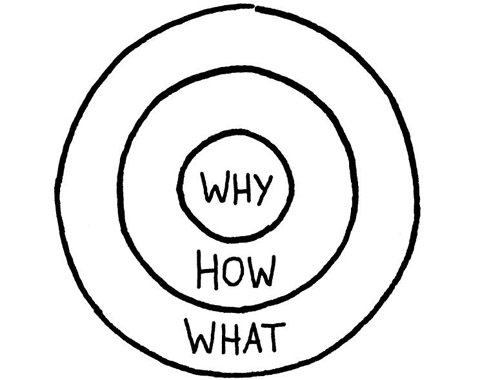
Golden Circle

Thinking Differently

 I sat next to a woman on my flight this weekend who was returning from an intensive corporate training session for an well-known chain.  When I asked her if she could define the central belief of the company she responded, ‘profit is in the little details.’  That is an actionable sentiment but I was perplexed as to how it could reflect the organization’s core belief.  It might be a ‘how’ in Simon Sinek’s Golden Circle but not the ‘why.’ It was a safe response but not different or inspiring.  After three weeks this was at the top of her mind.  It reminds me of Hugh Macleod’s cartoon about climbing a ladder to nowhere.  The tag line feels like progress but it is unsupported.  As Simon says, ‘people do not buy what you do they buy why you do it.’

Looking to think differently and surround yourself with those who choose an unconventional approach?  Chris Guillebeau’s World Domination Summit is about to open the next round of registration.  This is the most compelling and inspiring conference I attend each year.  It fascinates, expands my way of thinking, and provides a safe platform from which to discuss innovative ideas.  If you are looking to lean your ladder against something, make sure it is worth climbing.

Circle of Safety

Simon Sinek’s Golden Circle has served as the headwaters from which highly inspired individuals have articulated their purpose and launched ambitious expeditions.  I recently attended a session with Simon in New York City to gain insight into the next chapter.  Simon previewed the Circle of Safety.  The concept was simple to grasp and highly applicable.

The Circle of Safety has a strong overlap with Seth Godin’s philosophy of Tribes.  A fundamental driving force for humans over time is the need to survive which generates a need for safety.  In the caveman era, those who got the most to eat were expected to be the first and most potent line of defense when danger appeared and threatened the welfare of the collective.  In exchange for the prime position after the hunt, the strongest and biggest were charged with the survival of the entire group.  It was part of the leadership agreement.

We see this same dynamic on a daily basis.  We interact with people who provide a Circle of Safety for us or test our circle.  Southwest Airlines is an ideal illustration.  They have intentionally created a Circle of Safety for their employees, inclusive of the gate agents and luggage handlers.  These individuals are in the circle and therefore can execute their best work.  Try a legacy airline where many a gate agent is left to protect their job and therefore is left to survive each encounter.  Southwest would rather have a disappointed customer patronize another airline before they disrupt the Circle of Safety for their employees.  Simon’s refrain is that the strongest organizations protect the people on the edges, not just those in the executive suite.

If we are hoping to inspire others, we must offer a secure place from which to feel human and facilitate genuine interactions.  If the employees are authentic then customers feel safe to interact with each other.  Notice the social candor during the Southwest boarding process versus a legacy carrier.  Southwest passengers actually talk with each other and smile.  Rare is the same experience on other domestic airlines, unless the journey has become so fraught with obstacles that passengers are placed in survival mode and start forming temporary Circles of Safety to overcome that which threatens them.  If we wish for members of our tribe to go forth and act as ambassadors, advocates, or even askers, we must provide a safe place from which they can launch their journey.  Transformational acts come when we feel powerful and want to leverage this privelaged opportunity to help others.  

How big is the Circle of Safety in your enterprise?  Does it extend to the edges or is there an inner court?  What would your members, volunteers, and customers say?  What is the most inspiring or innovative act a member of the tribe has performed on behalf of the cause?  Have they deconstructed what allowed them to undertake such a quest?  As social animals the greatest bond in conceiving a human Circle of Safety is our ability to provide for others.  If we wish to do our best work we must have a mindset that is more expansive than just surviving.

Sleuthing and the Golden Circle

Simon Sinek’s Golden Circle

I had the pleasure to present to a class of students working in or preparing to join the nonprofit sector.  A question was posed about how to understand an organization’s “why” if the nonprofit cannot articulate their belief.  After providing my best on the spot answer I thought more about how to decode an enterprise’s “why”.  Here are some strategies that have served me:

  • Most organizations have immense amounts of literature, online content, and stories about “what” they do.  They can tell you every program, service, and metric.  This is low hanging fruit and easy to slot into the “what” portion of the Golden Circle.
  • The sleuthing begins when you unpack the organization’s “how.”  Begin by asking what values are important to an organization when they select a program or service?  How do they deliver their services? What is the organization’s hallmark?  Why?  What people do they hire to join the team and why?  How does their Help Wanted sign read?  How are they uniquely positioned to fulfill their mission?  Somewhere in these questions one will begin to assemble the “how.”  Remember that “how” is not tangible, instead it is commitments to maximizing a cause’s purpose.
  • The “why” may appear a void but these shortcuts may help.  Ask why the cause was founded.  What problem or opportunity was the founder trying to impact and address?  Founders are amazingly coherent when articulating the purpose of an organization.  Ask the founding story or what the early years were like at the cause.  Consider a query about the organization’s current signature event/program?  You can even use the Seth Godin approach and ask if one were to describe the organization’s greatest super power, what would it be? Lastly, you can always ask the Chief Executive or most visionary employee why they chose to join the cause?  What do they believe that the organization amplifies?
The cause may not be ready to discuss its “why” but with some leading questions one should be able to assemble enough information to understand the enterprise’s purpose.

What question’s do you ask to get to “why”?