Some dream just take longer to actualize than others.
Innovative Concepts
The Spotlight

Leadership is not about standing in the spotlight and talking about yourself. Leadership is getting others to stand in the spotlight and empowering them to share their gifts. The stage is a platform from which one can preach or engage. If you find yourself talking about ‘my’ or ‘I’, perhaps your motivation is the celebrity of the title and the accoutrements of office. If you speak about ‘we’ and ‘us’ then you are representing the tribe that is united around a belief. Leaders work the spotlight seamlessly, moving its beam to illuminate the highlights of those who have volunteered. Leaders stand it the spotlight’s glare when accountability is needed, apologizes are required, and contrition is appropriate. If you find yourself squinting, perhaps you need to exit stage left and allow the talents of your team to shine. Our job as leaders is to cast the roles and direct the play, not take the lead.
I stand here before you not as a prophet but as a humble servant of you, the people. Your tireless and heroic sacrifices have made it possible for me to be here today. I therefore place the remaining years of my life in your hands.
Nelson Mandela- on the day he was released from prison
I Believe
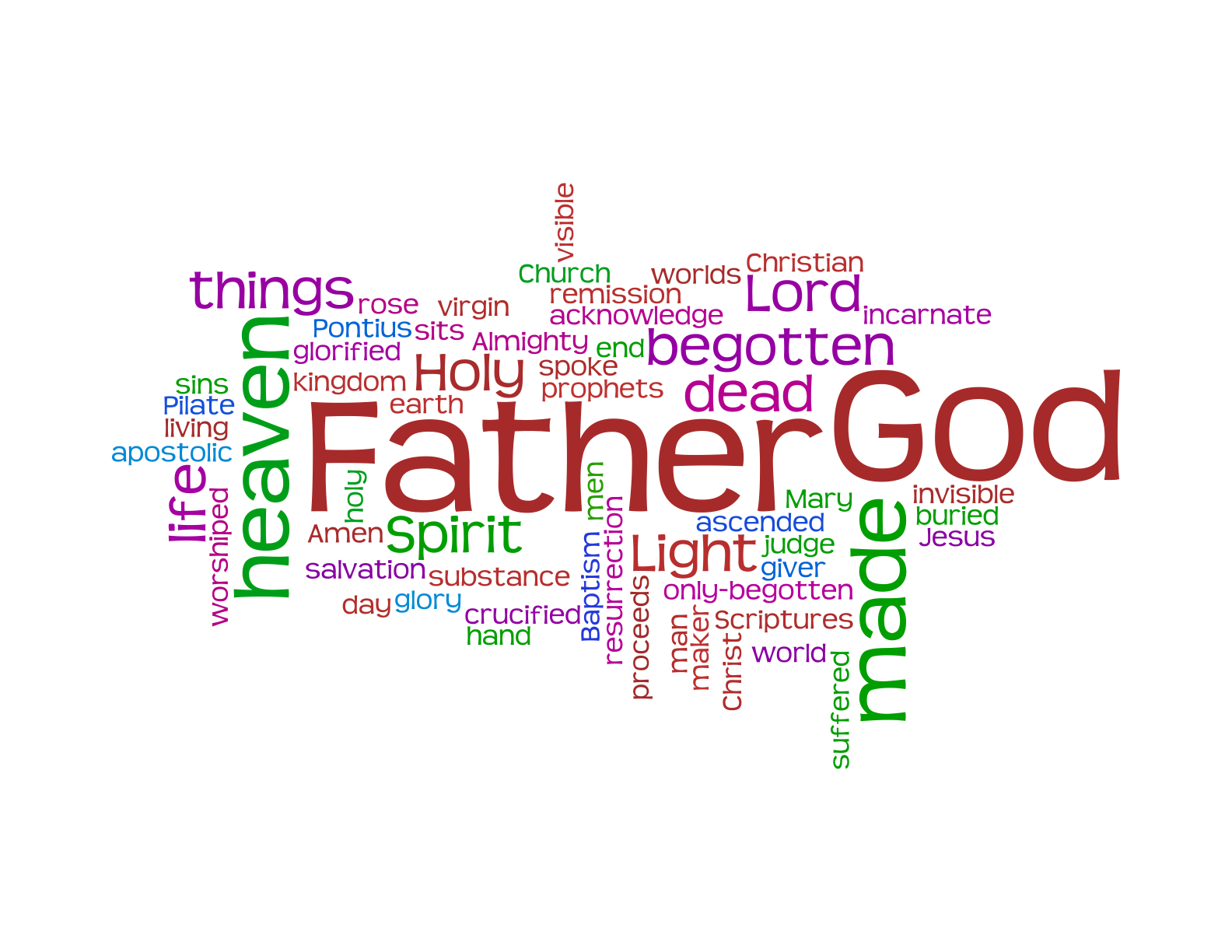
It struck me this weekend that religion does a better job than most causes in stating exactly what it believes. Take the Nicene Creed from the Episcopal Church.
We believe in one God the Father Almighty, Maker of heaven and earth, and of all things visible and invisible.
And in one Lord Jesus Christ, the only-begotten Son of God, begotten of the Father before all worlds, God of God, Light of Light, Very God of Very God, begotten, not made, being of one substance with the Father by whom all things were made; who for us men, and for our salvation, came down from heaven, and was incarnate by the Holy Spirit of the Virgin Mary, and was made man, and was crucified also for us under Pontius Pilate. He suffered and was buried, and the third day he rose again according to the Scriptures, and ascended into heaven, and sitteth on the right hand of the Father. And he shall come again with glory to judge both the quick and the dead, whose kingdom shall have no end.
And we believe in the Holy Spirit, the Lord and Giver of Life, who proceedeth from the Father and the Son, who with the Father and the Son together is worshipped and glorified, who spoke by the prophets. And we believe one holy catholic and apostolic Church. We acknowledge one baptism for the remission of sins. And we look for the resurrection of the dead, and the life of the world to come. Amen.
There is not a lot left unsaid. The picture of what the church stands for is pretty well stated in this creed. How well does your enterprise communicate its creed?
The Real Reward

My friends who worked as waiters and waitresses talked about the $100 tip. They would return to a table they had served to clean-up and find an extraordinary tip the when calculated added up to far beyond the normal percentage. It was like winning the jackpot in their minds. The tip was a form of victory. Then the question came, what next?
Another friend said the best tip they received was an offer to work at a patron’s company. The individual was not offering an immediate reward but was making a longer-term commitment in my friend’s talents. The pay-off took longer but the impact was far reaching.
What rewards are you offering? Which ones are truly meaningful?
Death Star Growth

My son wants a Lego Death Star. I told him I would buy him one block a day and we figured that it would take 3,803 days. I then suggested he could get it faster if he compounded the number of blocks. Turns out he could have all the pieces for his Lego Death Star in13 days. I makes me wonder, where are the organic opportunities within each enterprise to experience exponential growth?


The Risk of Dreaming
Sometimes it does not work as anticipated. Occasionally, you are not successful but the real question is what did you learn?
Wonderland from catherine Hyland on Vimeo.
My Best Idea

After a failure, have you heard a person claim that the idea was not their best one and that they have another one ready to try? I think this is brilliant. If after a failure you have a better idea (even if it appears to be saving face or facilitating ones ego) is the sign of engagement. I worry when there is not better idea after a a lack of success. With additional data and insight gained from a failure a fresh reconfiguration of strategy is the sign of energized engagement. Get excited about the ‘new’ best idea, not immediately dismissive. Does your enterprise embrace a better best idea or is it met with cynicism?
Faith

I’ve ridden my bike in some amazing locations this summer. I have experienced some of the best and worst of road conditions. The most trying moments come when the shoulder on the road does not exist or is filled with potholes. Trying to ride safely, not impede traffic takes a lot of concentration. Knowing that my safety is contingent on passing vehicles providing me enough room takes faith.
How many activities does your enterprise undertake that relies on faith? Grants? Volunteers? Board Members? Programs? Partners?
Know Your Strengths

Being willing to make a change to enhance your strength is a tough call. When you have done something well for a period of time it is easy to stay the course. On a recent Southwest flight which was full, I learned that the airline had decided that in the coming months it would no longer continue its scheduled service between the cities I was traveling. Turns out that short duration flights are not longer the ideal for Southwest. They are finding success on slightly longer legs where the planes do not have to be turned around in such rapid fashion. Southwest understands optimizing its operations means sacrificing a route that may be currently profitable.
How do you maximize your causes strengths?
Circles

With all the excitement around Google+ and the circles feature it reminded me of the circle strategy being used by the social sector as a way to manage advocates and advisers. So often, large advisory boards or councils are created as a place to keep those who are important, influential, philanthropic towards ones cause but may not be ready, willing, able to serve on the board. As the names and influence grow these councils can become challenging to steer, especially when there was dissension about organizational strategies. I have watched founders and key supporters on advisory councils that were inactive suddenly leap into action to ‘save’ an organization from a decision they deemed harmful or inappropriate. This can cause a lot of anxiety and diplomacy for a Board Chair and CEO.
One way to address the adviser role is to create circles. For example, there might be President’s Circle. Individuals the President can call upon to seek advice and council. Communication and engagement does not need to be scheduled but if the request for input is sincere and meaningful, the advisers stay connected. Usually this is a group that requires a meaningful touches and communication but may not meet as a formal body. Board Chair Circle, Development Circle, Marketing Circle, Volunteer Circle, Community Cirles are some common examples. Appropriate staff or board leadership can facilitate these circles. It also provides a nice vehicle to connect to advocates who have specific talents and are willing to be a resource for the cause.
What circles are you formally or informally managing?
 What-if-concepts