Strategic Planning

The Board’s Role

Star Trek’s Captain Picard use to utter, “make it so” and the command became action.  I often find a parallel in strategic planning.  Boards dream great visions, set lofty goals, and turn to their Executive Director and in either word or action say, “make it so.”  The consequences of vision without resources can be overwhelming and disheartening from the staff’s prospective.  An in-tune board chair must comprehend the bandwidth of the enterprise.  Consider asking the following questions to the board:

  • Do we have the expertise to manage the goal?
  • What resources are required?
  • What role can the staff play?
  • What role does the board need to take to champion the goal?

There is a difference between “make it so” and “let us all commit to the initiative.”  I would suggest that often a strategic initiative is treated like a ‘to do list’ which can be leveraged to another party.  A true strategic priority requires all parties to participate, much like a summit attempt on a high alpine peak.  Without the commitment of the entire party, the rope lines and high camps cannot be established and no individual can be placed high enough to summit the peak.  “Make it so” should be “let’s go.”

Road Trip

Strategic planning often divides on the willingness of a cause to think beyond the horizon line.  If you take a road trip and plan to drive 300 miles the first day, that is the equivalent of an operational plan.  You can reach the goal with a sense of certainty.  You can plan the stops and even calculate the amount of gas you need.  If you plan to go from Maine to Anchorage, then you have to assume a strategic view.  You can estimate the number of days, the possible routes, and some resources required.  You also have the option of considering different modes of transportation (boat, plane, train, bike).  

It is easy to schedule a 300 mile day trip.  It takes courage to launch for distant shores.  But the ability to steer your cause towards the destination is what makes your purpose meaningful both in a day-to-day measurement and throughout the journey.


Image planning to put a rail line across the continent.  That was a strategic initiative.  You knew the destination but encountered many unknowns along the way.  A certain destination kept the purpose clear throughout a very challenging task.

Commanders Intent

I was reminded of the importance of Commander’s Intent when speaking with a colleague yesterday.  He handed me an operating plan for a marketing campaign and wondered, ‘why aren’t we making any progress?’  I reviewed the document and questioned if he had motivated and professional staff working on the execution.  He raved about their skills.  I then pointed to a one line-items and said, ‘perhaps you can allow them more flexibility to complete the project.  In his enthusiasm to write the plan he had provided ever detail, down to the shopping list at the office supply store.

The book, Made to Stick, by Chip Heath and Dan Heath was one of the first to introduce me to the idea of Commander’s Intent.  A military philosophy that basically boils down to a commander ordering his team to ‘take that hill.’  Commander’s role is over besides monitoring the status of his order.  It is up to the field officers to determine the best strategy.  If they want to storm the hill, use artillery, parachute, or surround it, the tactical choices are made by those on the ground.  Strategy comes from the command but execution is left to those who will carry it out.  

It is always a slippery slope assessing where the line between planning and managing exists.  Sometimes it is helpful to ask, am I asking for the hill to be taken or telling the troops what route is best?  If you have hired and trained the best individuals, commander’s intent provides direction without suffocating creativity.

Innovation or Business As Usual?

Reading the book, The Leader Who Had No Title by Robin Sharma and I was struck by the following passage.

‘In the new world of business, the riskiest place you can be is trying to do the same thing in the same way as you’ve always done them.  Few things are as foolish as hoping old behaviors will somehow present new results.’

The social sector has been quick to innovation on some fronts and tied to the volumes of history in other areas.  The sector was the fastest to adopt to the promises of social media.  Many nonprofits found Facebook to way to claim a stake in the internet’s version of the Homestead Act.  Every enterprise was trying to get their virtual forty acres.  The Facebook application Causes was ideally suited to handle the growing swarm of grassroots campaigns.  On the other hand, many nonprofits were slow to respond to the current economic crisis.  There was much delay in considering cost-cutting, laying-off employees, merging or even closing the doors.  I noticed many for-profit businesses were far faster to make adjustments.  The social sector turned to its donors and asked for critical operating support with urgency. Soon each group’s message was lost among a cacophony of organizations trying to champion their dire situation.


We know that the old model will not work in a new economy.  Donor’s interest have moved, priorities have shifted, corporate giving has undergone a massive transformation, the collective memory of 2008-2009 will remain etched in the Baby Boomer’s memories (among other generations).  Those that the sector most planned to sustain us with financial contributions, time and talent may be less able.  So what has your organization done to amend the way it does business?  Did you adjust to survive the recession and plan to return to business as usual?  Have you altered your strategic plan to take advantage of opportunities that were unimaginable 18 months ago?  Are you still considering yourself a victim of a global economic crisis or has your enterprise become a entrepreneurial leader?

The book makes another point.  ‘The space shuttle uses more fuel during its first three minutes after liftoff than during its entire voyage around the earth.’  So often you find that launching an idea into orbit takes a tremendous amount of energy and commitment.  So much so that we frequently leave our ideas on the launch pad waiting for another day and more favorable conditions.  How can you combine innovation and your organization’s authenticity to find a new orbit?  As I wrote about last week, NASA is being given a new vision, the moon is being left to private industry and Mars has become the next challenge.  If your competitive advantage consisted of programs focused solely on the moon the game has changed.  Are you ready?

Deadlines and Destinations

The debate taking place within the NASA community concerns the future role of the agency.  President Obama recently highlighted his mission for NASA when he spoke at the John F. Kennedy Space Center on April 15.

“So the point is what we’re looking for is not just to continue on the same path — we want to leap into the future; we want major breakthroughs; a transformative agenda for NASA…  Critical to deep space exploration will be the development of breakthrough propulsion systems and other advanced technologies. So I’m challenging NASA to break through these barriers. And we’ll give you the resources to break through these barriers. And I know you will, with ingenuity and intensity, because that’s what you’ve always done.”

President Obama        

What has some NASA insiders concerned is that there is no specific mission.  President Obama has presented a vision but some space supporters are concerned that it is not compelling enough. 

“Talking about a goal like that so far in the future- anyone can do that…What is the vision for NASA?  One of the things that the old hands at the space agency all say is absolutely crucial is timetables and destinations.  A firm destination and some idea of when you hope to be there.  The open-ended nature of what the Obama Administration is proposing has bothered some of those space hands…folks are worried about the long-term survivability of this plan”

William Harwood- CBS New Space Analyst              

Many of us who were alive during the moon landing or grew-up in the shadows of its legacy can recall the power of President Kennedy’s famous refrain, “send a man to the moon by the end of the decade.”


When planning organizational goals, how important is a deadline and a specific destination?  I would argue to NASA it is everything.  Study projects, congressional funding, attracting astronauts, sustaining key independent contracts, retaining the best and brightest assembled around a specific itinerary. 


How important are deadlines and destinations to your organization?  Deadlines force you to thrash early and then ship (see April 14 blog post).  Destinations provide direction.  If we agree that Jim Collin’s challenge to get the right people on the bus and then put them in the right seats is essential to success- can we also agree that the bus better be headed to a compelling destination?

The Backboard

If you are hitting against a tennis backboard you next shot is dictated by your last stroke.  The height, speed, spin are already inputs as the tennis ball bounces against the backboard.  If you are playing another person your challenger can alter the inputs and completely change the pace, location and appearance of the return.

I am reminded of this when organizations only look internally for clues about their culture, strengths and perception.  Performing a SWOT (strength, weakness, opportunities, threat) analysis by asking only insiders to respond has challenges.  Some organizations have a strong resistance to ask the broader community about their perception of the enterprise.  There is a belief that what the board, staff and close donors perceive about the organization is what the rest of the community sees.  SWOT analysis can be like planning tennis against a backboard, you control the inputs.

What is the cost of planning for the next 3-5 years without confirmation of how the community perceives your organization?  What is the value of asking for advice from your members and community?  Are you transparent if you do not include a broader constituency in your planning? 

Filling the Agenda

In the past couple of weeks I have facilitated two organizational retreats that covered approximately the same material.  One was scheduled for four hours and the other was scheduled for seven.  As I sort through my notes and consider what was accomplished during both sessions and the results were the same.

The difference in my mind was the work done in advance by the organizations.  One group was very clear about what questions needed to be answered and what the deliverable was at the end of the retreat.  The other was also focused but tried to cover a wider range of topics during the course of the retreat.  Their outcome was to refresh an existing document.

I came away with an appreciation for clarity and focus.  Group planning sessions are more productive when you take the following steps:

  1. Agree on an outcome before you start planning
  2. Ask for input from the participants.  For example using an online survey, interviews or focus groups
  3. Filter the information and develop specific questions or decision-making opportunities for the group
  4. Have the support and commitment to the outcome from the organizational leadership
  5. Allow the group attendees to react to the information and provide suggestions, alternatives or agreement
  6. Capture off-the-subject items in a “parking lot” list and then return to those topics at the end of the session to decide if they still need to be discussed or assign a plan of action for each one
  7. Create agreement about the expectations for moving forward from the session
  8. Report back quickly and share meaningful updates/drafts for the group to review and approve
  9. Celebrate success

As a facilitator it is almost as much work to prepare a half-day as a full-day retreat.  However, the best retreats seem to honor people’s time and energy levels.  It is easier to keep the tempo high, the energy flowing and a small sense of urgency over three to four hours than seven or eight.


What has been most effective for your organization?  How do you balance scheduling and planning?  Would you consider paying more for the same result in less time?

Jet Fuel and Supplies

Does your organization have a budget that forecasts three years from today, five, ten, or twenty?  Has anyone taken into account that the new building you about to put online will increase utility and maintenance costs?  Is there a line-item to show that the grant which has allowed the organization to hire two full time equivelant employees will expire in two years?

Many organizations hold strategic planning session and annual retreats to try and expand their horizon somewhere beyond the next board agenda.  The ideas and concepts that are developed are often inspiring.  A great retreat can plaster the most dynamic and liberating ideas all over the walls with the help of Post-Its and large poster boards.  The energy is palpable and the groups exits with the belief that their organization is going to shine brighter than ever.  What so often gets missed is the power of inertia.  If the financial realities of the planning is not developed in concert with the ideas, there will be no fuel in the rockets and breaking your organization’s current orbit will be impossible.  A year goes by and the organization is on the same trajectory, circling the same star, in the same order it has always held.

Part two of a great planning exercise should be the consideration of the resources required to launch the initiatives.  It takes a tremendous amount of power to break an organization’s current orbit.  Change can be scary, difficult and require lots of energy.  When it is happens it is remarkable and can alter the shape of your universe.

7x

If you were notified that your projected lifespan had been reduced by a ratio of seven (a day now equals a week), would you do anything differently? What would if look like if you were informed that you lifespan had been extended seven-fold (each week is now 49 days long)?

Running with our dog during a cold snap yesterday I was amazed by her joy of generating a frosty fur coat. I began to ponder a dogs lifespan. If a year in a dog’s life is equal to roughly seven years in a human, each day is essentially a week for a dog. Scarcity of time makes for some interesting adjustments in priorities. A run for her is a weeks worth of living, no wonder she is excited to get out.

Many nonprofit organizations and foundations have a belief that they will exist in perpetuity. Others believe they will continue until a cure is found or a cause is no longer relevant. This sense of an open-ended engagement is powerful and yet challenging. How do you keep motivation and generate a sense of urgency in front of your board and staff along with your donors and constituents? I see staff members who joined organizations with a passion for solving a problem or meeting an essential need and now find themselves on a pseudo corporate treadmill ticking off the years. Governing documents are designed to extend the life of most nonprofits and foundations unless a sunset clause is embedded. Most strategic planning retreat do not focus on how to put the organization out of business because the need has been met and no longer requires the enterprises programs; rather the planning retreats focus on positioning the organization as being the leader and thriving in the future.

If your organization was informed that it had seven years to tackle the most important issues and then would be disbanded, what actions would you take? Does your enterprise seriously discuss a future without your presence? How do you embed a sense of urgency in the deliberation of your organization’s work? How do you renew the passion of your followers and fans?

CrowdSourcing and Game Forecasting

I have been spending some time reading and thinking about game forecasting and crowdsourcing (see 8/17 post). This was all triggered by an article in the Sunday New York Times magazine last weekend. The article highlighted the work of Bruce Bueno de Mesquita and his method of using a proprietorial software program to uncover potential outcomes to global questions. http://www.nytimes.com/2009/08/16/magazine/16Bruce-t.html

I have been pondering the impact of this technology on the nonprofit and social sector. Clearly these fields have their own unique global questions. Donors are constantly trying to help move forward specific initiatives. Partnerships are formed. Movements dissolve. Do a few individuals control the fate of a cause or is it the will of the masses?

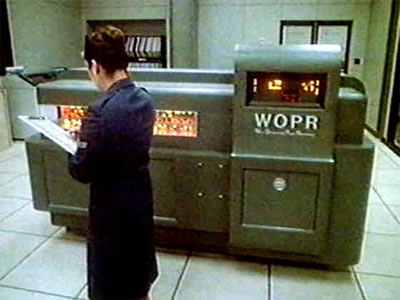
The 1983 drama-adventure film WarGames exhibited the futuristic WOPR supercomputer. The mainframe churned away on possible outcomes to nuclear war all the while undeterred by human attempts to over-ride its program. Although a Hollywood version of artificial intelligence, the movie highlighted the possibilities of game forecasting. The questions I ponder is the role this technology and method on the nonprofit sector. Will potential capital campaigns no longer use feasibility studies but rather turn to a software program to generate a numerical probability of success? Will future partnerships and mergers have to demonstrate viability via game forecasting before the respective boards will proceed? Will strategic plans retreats be run online in much the same way the television studio audience votes for their favorite clip on America’s Favorite Home Videos? Are we headed for a new level of sophistication or potentially a different master?