Author: whatifconcepts

Empowering those that inspire so they can excel at the work that matters.

I Cannot be Bothered

The white terrier raced down the trail at full alert.  It proceeded to swing behind me on the single track foothills trail and nip at my heals as I continued my run uphill towards the descending dog’s owner.  For three minutes I was corralled by the terrier as it barked and nipped at me.  Reaching the dog’s owner (who offered no verbal instruction to the dog) she apologized halfheartedly and continued on.  The terrier was already racing off to chase the next hiker behind me.

We all have habits we have no intention of correcting.  Acts that break the social contract or do not conform with expected practices.  If we are authentic in our communication about these behaviors, people will give us latitude.  However, when we ignore them and act as if they happen in isolation on rare occasions, it breaks our trust.  We embrace the eccentric when we understand.  However, pretending to be one way and acting another with not intention of changing does not breed loyalty.

The 12th Step

<!– /* Font Definitions */ @font-face {font-family:"MS 明朝"; panose-1:0 0 0 0 0 0 0 0 0 0; mso-font-charset:128; mso-generic-font-family:roman; mso-font-format:other; mso-font-pitch:fixed; mso-font-signature:1 134676480 16 0 131072 0;} @font-face {font-family:"MS 明朝"; panose-1:0 0 0 0 0 0 0 0 0 0; mso-font-charset:128; mso-generic-font-family:roman; mso-font-format:other; mso-font-pitch:fixed; mso-font-signature:1 134676480 16 0 131072 0;} @font-face {font-family:Cambria; panose-1:2 4 5 3 5 4 6 3 2 4; mso-font-charset:0; mso-generic-font-family:auto; mso-font-pitch:variable; mso-font-signature:-536870145 1073743103 0 0 415 0;} /* Style Definitions */ p.MsoNormal, li.MsoNormal, div.MsoNormal {mso-style-unhide:no; mso-style-qformat:yes; mso-style-parent:""; margin:0in; margin-bottom:.0001pt; mso-pagination:widow-orphan; font-size:12.0pt; font-family:Cambria; mso-ascii-font-family:Cambria; mso-ascii-theme-font:minor-latin; mso-fareast-font-family:"MS 明朝"; mso-fareast-theme-font:minor-fareast; mso-hansi-font-family:Cambria; mso-hansi-theme-font:minor-latin; mso-bidi-font-family:"Times New Roman"; mso-bidi-theme-font:minor-bidi;} .MsoChpDefault {mso-style-type:export-only; mso-default-props:yes; font-family:Cambria; mso-ascii-font-family:Cambria; mso-ascii-theme-font:minor-latin; mso-fareast-font-family:"MS 明朝"; mso-fareast-theme-font:minor-fareast; mso-hansi-font-family:Cambria; mso-hansi-theme-font:minor-latin; mso-bidi-font-family:"Times New Roman"; mso-bidi-theme-font:minor-bidi;} @page WordSection1 {size:8.5in 11.0in; margin:1.0in 1.25in 1.0in 1.25in; mso-header-margin:.5in; mso-footer-margin:.5in; mso-paper-source:0;} div.WordSection1 {page:WordSection1;} –>


Addiction programs of note have 12 steps to recovery.   Individuals who complete 11 of 12 steps have a higher likelihood to lapse back into their addictive behavior than those who complete all the steps.  Said differently, individuals who make it 90% of the way stumble far more than those who go one level further.  What makes the 12th step so powerful?  The 12th step is a commitment to mentor another person who has suffered from the addiction.  The act of giving ourselves in the service of others has a profound and lasting impact.

If a friend tells you they donated $1,000 to a charity it may be impressive but it might not be a transformational act.  If your friend told you they gave their Saturday to refurbish a charity’s program center, we are inspired.  The commitment of our time and expertise has more of a far-reaching impact than the investment of capital.  The act of donating our time is valued more than our treasure.  If we offer our time in the service of others it inspires and builds a committed tribe.

* Another post from a day with Simon Sinek in New York City.

Lesson from the River of No Return Wilderness

If you move at the same speed as the river, you have no control over your line, you go where the river takes you.  However, if you travel faster or slower than the river’s current, you can select your course.

National Outdoor Leadership School Instructor

We often accept the pace of those around us as our pace. It is a default mechanism and it provides safety in numbers, stay in the herd.  This is an appropriate strategy if we are walking in a crowd or waiting in line.  However, the route to our destination does not need to be tied to the pace selected by somebody else, they have their own motivations in mind.  In order to truly maneuver, we must be willing to apply our power and select a path. The river may or may not have our best interest in mind as it flows through the canyon.  You however have the opportunity to determine the outcome by using your strengths.

The Cirlce of Safety and Profits

A case study to further illuminate the Circle of Safety.  I read an article by David Auerbach, a former Microsoft manager who discussed the pitfalls of the employee “stack” ranking system.  The stack predated Steve Balmer’s tenure as CEO but was continued as a core assessment process.  Mr. Auerbach recounted the fate of employees who were placed in a series of performance buckets on a scale of excellent to awful.  The rankings sealed the employee’s future career path at Microsoft and was the basis from which bonus schedules were calculated.  The manager’s job was to advocate for their best employees and allow the lower performers to drop as far as necessary in the rankings while maintaining negotiating power for employees they preferred.  This process was the antithesis of the Circle of Safety.  The stack does not promote human interactions and germinates distrust and secrecy.  The Circle of Safety does not avoid employee firings but it reflects on the impact to the community with a more thoughtful and humane approach to help those who may not be able to maximize their talents.

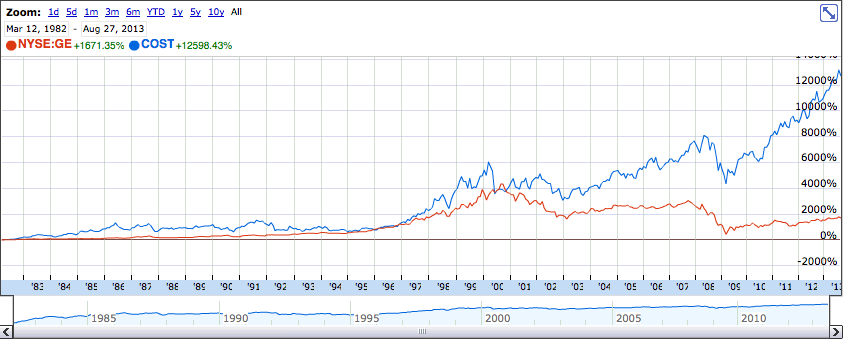
General Electric was the classic model of a company that would let go of the bottom 20% of its employees on an annual basis.  If you did not perform, you did not stay.  This created a very competitive environment but also one in which trust, innovation, and risk were not worth building.  Contrast this with Costco, a company that pays a living wage and invests in its people.  The Circle of Safety extends to the edges.  The investment community would suggest that GE practices the hard-hitting principles that make for strong quarterly results.  However, Costco has actually outperformed GE over long-run (see chart below), providing a blueprint that treating the employees as something other than a commodity is possible and prosperous.

Costco vs GE

A key attribute of an enterprise that embraces the Circle of Safety is that it does not make employment decisions based on a balance sheet.  Instead a Circle of Safety organizations think first about what is best for the community and then secures the resources to support the community.

* A continuation from the Day with Simon Sinek

Circle of Safety

Simon Sinek’s Golden Circle has served as the headwaters from which highly inspired individuals have articulated their purpose and launched ambitious expeditions.  I recently attended a session with Simon in New York City to gain insight into the next chapter.  Simon previewed the Circle of Safety.  The concept was simple to grasp and highly applicable.

The Circle of Safety has a strong overlap with Seth Godin’s philosophy of Tribes.  A fundamental driving force for humans over time is the need to survive which generates a need for safety.  In the caveman era, those who got the most to eat were expected to be the first and most potent line of defense when danger appeared and threatened the welfare of the collective.  In exchange for the prime position after the hunt, the strongest and biggest were charged with the survival of the entire group.  It was part of the leadership agreement.

We see this same dynamic on a daily basis.  We interact with people who provide a Circle of Safety for us or test our circle.  Southwest Airlines is an ideal illustration.  They have intentionally created a Circle of Safety for their employees, inclusive of the gate agents and luggage handlers.  These individuals are in the circle and therefore can execute their best work.  Try a legacy airline where many a gate agent is left to protect their job and therefore is left to survive each encounter.  Southwest would rather have a disappointed customer patronize another airline before they disrupt the Circle of Safety for their employees.  Simon’s refrain is that the strongest organizations protect the people on the edges, not just those in the executive suite.

If we are hoping to inspire others, we must offer a secure place from which to feel human and facilitate genuine interactions.  If the employees are authentic then customers feel safe to interact with each other.  Notice the social candor during the Southwest boarding process versus a legacy carrier.  Southwest passengers actually talk with each other and smile.  Rare is the same experience on other domestic airlines, unless the journey has become so fraught with obstacles that passengers are placed in survival mode and start forming temporary Circles of Safety to overcome that which threatens them.  If we wish for members of our tribe to go forth and act as ambassadors, advocates, or even askers, we must provide a safe place from which they can launch their journey.  Transformational acts come when we feel powerful and want to leverage this privelaged opportunity to help others.  

How big is the Circle of Safety in your enterprise?  Does it extend to the edges or is there an inner court?  What would your members, volunteers, and customers say?  What is the most inspiring or innovative act a member of the tribe has performed on behalf of the cause?  Have they deconstructed what allowed them to undertake such a quest?  As social animals the greatest bond in conceiving a human Circle of Safety is our ability to provide for others.  If we wish to do our best work we must have a mindset that is more expansive than just surviving.

The Amazing Part About Seeking Rejection

I do not seek out rejection.  I prefer collaboration and diplomacy.  It strikes a cord of harmony.  If an enterprise is going to build momentum it is best if everyone shares the same belief.  However, I am always on the lookout for great questions and unique perspectives, techniques to view a location from multiple vantage points.  One places this magic reveals itself is during the annual World Domination Summit, a gathering of creative people living unconventional lives.  The speakers, their messages, and the attendees were so profound in 2012 that I encouraged my wildly creative and young adult book aficionado wife to attend with me this year.  Perhaps the most potent moment of the weekend was a talk given by Jia Jiang.  He purposely placed himself at the edge of the proverbial rock ledge know as rejection and looked for people to push him so he could build a desensitization to the fear of rejection.  He shared his narrative and the amazing twists in his story when he started asking strangers to engage him in unique ways.

Jia Jiang from Chris Guillebeau on Vimeo.