Consulting

A New Way

Charity is dead.

The ‘E’ in CEO stands for ‘excuse me can you spare dime.’

The enterprise that has the most connections and funders wins the war for fundraising success.

Nonprofit organizations tweet, friend, link, blog, post, Evite, refresh, and blast in a constant attempt to gain market share and recognition.

More time is spent reaching out to volunteers, donors, patrons, foundations, politicians than they spend achieving their mission and running key programs.

Resources are frequently shifted in order to make an organization eligible for funding, awards, volunteers, community recognition, grants, facilities. New programs are adopted simply to meet the demands of a third party.

The number one attribute for nominating a new board member- capacity to give.

What if…
  • Nonprofit organizations spend 90% or more of their time and resources meeting the mission
  • Special Events and Gala fundraising events that typically cost 30 cents for every dollar raised become a gathering to report back to the supporters, volunteers, customers, partners, politicians. Exchange ideas, get feedback, engage, build community, connect.
  • General operating support should receive the highest deduction from the IRS. The more restrictions of the gift, the less deduction. Allow the board and staff decide what is the best way to use the resources and then provide constant communication and transparency.
  • One metric does not fit all nonprofit organizations. There is no perfect Return on Investment formula. Measuring success is an abstract exercise that rests in the liminal.
  • FOCUS: Announce your intentions and go do it. The fewer peripheral pieces the better. Stop hiring the best fundraiser as CEO if that is all they bring to the enterprise. Get the best leader, manager, strategic thinker, communicator, advocate, collaborator, visionary, and whatever else you need. Hire for the cause not the funders.
  • Be brave: go out and partner, leverage parts of your mission to other organizations that are better positioned to provide a service, share your challenges, be targeted.

Many more ideas to follow in a developing manifesto…what would you suggest to change the social sector? Is it really working?

To Plan?

Many businesses and nonprofit organizations that I communicate with have decided to put any long-range or strategic planning on hold. Most often the economics of hiring a consultant are given as the main reason. Some clients are moving in-house by using a self-facilitated process where a board member or volunteer leads the effort. I applaud those who are still thinking about the future and wonder about the organizations that exist only in the day-to-day mode.

All of this came full circle last week when both planes that I was scheduled to fly on encountered mechanical issues while in the pre-flight stage. Neither was especially alarming but it re-enforce the status of the airline industry. New orders for planes are being deferred and new aerospace technologies are being considered but few are being implemented at the moment. What is going to happen when everyone feels the need to expand or ramp back-up? The deferred maintenance and investment in new aircraft is going to create a backlog that will arguably take a decade to clear.

What are the opportunities that your enterprise is missing because you are no longer holding planning sessions or scheduling retreats? How much is the day-to-day oversight of the balance sheet taking bandwidth from the organization’s ability to think strategically? It is as if everyone abandoned the wheel house to run down to the engine room to keep the power up but nobody is watching the seas. Who is in you Crow’s Nest scanning the horizon? If they exist, have you spoken with them recently?

Finite Thoughts


Listening to NHPR this past weekend and caught the conclusion of an interview about thinking and the brain. The author of the book (could not catch their name) promoted the idea of ‘cognitive cash’. The idea that we have a finite number of thoughts available to us during out lifetime. A number has been calculated on how many thoughts the average person has during their lifetime. How are you using your thoughts? How often do you spend it for a positive return on investment? Do you allow your thoughts to run free like a water running from an unattended garden hose? Does it matter?

When you add the idea of scarcity to an commodity suddenly the value increases. I have tried to think about this daily. How am I using my cognitive cash? Where and how am I willing to spend it?

How Many Letters Does It Take?


Waiting for a flight late last night and I am playing Hangman on my iPhone. I began to wonder how many letters do I need in place before I know definitively solve the puzzle? When does strategic guessing turn into certain selection of the remiaing letters. I am struck by the psychological shift that takes place the moment I ‘get’ the word and then type of the missing letters versus the ‘still guessing’ moments.

What can we do in our organizations and enterprises to help our customers complete enough of the word (or service) that their success is almost certain? What shifts can we make to increase their enjoyment and reward them? Think of websites that you visit, manuals that come with new equipment, airline limitation policies. Which ones make sense and which ones befuddle us and leave us more confused? If the customer ‘gets’ it right away they remember the name of the company. If the customer is frustrated they remember the story and share it with their friends and associates as a reminder of what does not work.

Are we supplying enough letters for the clients to win?

If A then B?


I wonder how often we stick with the conventional because if allows us to stay with a know entity and receive familiar outcomes? How many times do we change our route home? Do you ever breakout a different clothes? Do you try different stories at a social gathering? What do you order from the restaurant menu- could you spouse or friends guess your entree of choice? What assumptions control our behavior. I must do this because that is always the way it has been. Looking at some blogs this morning started me wondering:

  • What would the United States look like if Texas seceded from the Union? Would California leave next?
  • Why can’t a large ocean-going vessel protect itself from a motorized raft loaded with a few pirates?
  • Has the economic downturn increased our realization of what we value?
  • How will we go back to paying ‘full’ price for items? What will shift our consciousness away from demanding a discount?
  • If you received a free ticket that expires in one month would you fly half-way around the world to see a country you have always wanted to visit?
  • What role will books written about play in the future if consumers demand that you start a blog with a synopsis of your ideas first?

How quickly environmental factors influence our focus. What are you doing intentionally everyday? What parts of your life are left on default mode?

Who Do You Perform For?

Wandering by a half-opened door in the Morgan Library & Museum in New York City I heard the classical refrain coming from a piano located in the performance hall. I spied through the door and saw a musician practicing from the stage. I tested the door, found it open and then walked-in and stood at the top of the stairs for a few minutes. I took in the opulence of the room and then focused on the music. Listening to the rehersal made me wonder who the musician was performing for at this moment. Clearly this was practice and not a public concert. I was an audience. For ten minutes I listened and watched as the pianist practiced and sometimes replayed the same bars repeatedly.

‘Does a falling tree make a sound if nobody is around to hear it?’ Do you need an audience to give meaning to your work? Does a painter need a patron or an author a reader? This very blog- who is the audience? When we use our talent, does it have to be directed at a specific recipient?

The other day I noticed a woman in the car behind me smiling and it was contagious. She was in moving traffic and simply part of the flow, not trying to communicate with any one person but her smile had an impact.

A football game in an empty stadium- does it carry the same meaning as a game in a sold-out stadium? What talents are we sharing and what is our intended impact?

What information are you uniquely positioned to share?


The control of information- ever wonder how you can suddenly be focused on a topic that was not even part of your conscious thought? Reading the morning headlines from different sources I read the important information as well as the ‘off-the-radar’ pieces. As an example, USA Today offered the following online article:

A comic-book historian has unearthed hundreds of racy, violent and sadomasochistic cartoons by Joe Shuster, one of the creators of hero Superman.


How did this get to be front page news? Who selected it and why was it deemed important? Being able to control the flow of information is an amazing privilege and very powerful. I often wonder what each of us is uniquely positioned to provide as information? Your friend who always has the best stories that seem beyond reason. The blog that you read because it never fails to offer something valuable. The media source that you turn to first if you have been out of range for a day or two.

What information do people and businesses rely on us for?

Sunday Evening & Nonprofit Committees


Sunday evening arrives and clearly a weekends worth of activity has passed and now the psychological transformation to next week starts taking place. Thoughts of all the appointments, meetings, and ‘to do’ come bubbling-up. A bit of overwhelm seeps into what had been tranquil calm and now I find myself a wave of anxious energy racing towards the Monday seawall.

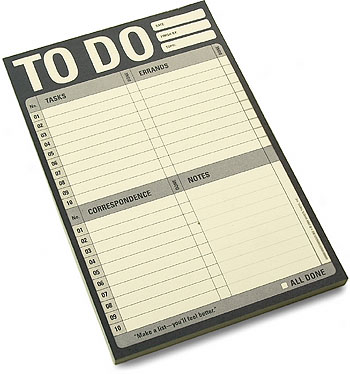
Solution- I take my pen and paper and jot down everything I can think of. This is half an exercise in capturing actual actions and half journeying. It all goes down on the list. On Monday morning I look at the lengthy list and start to prioritize. Using a code of my own design I separate the list into categories. Anything I can accomplish in less than three minutes gets one mark, business related, family, fitness & health, community, personal finance, etc. No everything gets categorized but the big items are collected into buckets. My week now seems to have clarity and I can make schedule time to work on each category.

The lack of planning is why many nonprofit organizations like a fully developed committee structure. It give the board an immediate place to assign a ‘to do’ or new action. However, not many Boards sit down and make their Sunday evening list first. They just take what comes at them as assigned or they start making busy work for themselves. The strategic plan (or compliance issues) should be guiding your committee’s work. If they are not then you might wonder if your organization is using the talents of the committee members most effectively and to the highest purpose.

The best committees I serve on typically are the of task force variety. They have a definitive purpose and deadline. Some nonprofit organizations adopt a ‘no standing’ (permanent) committees structure. Board Governance and Finance Committees are usually standing committees for every organization. Each year the Board assemble the best teams to meet the priorities of the organization.

A blank piece of paper can be an effective planning tool.

Trying New Things

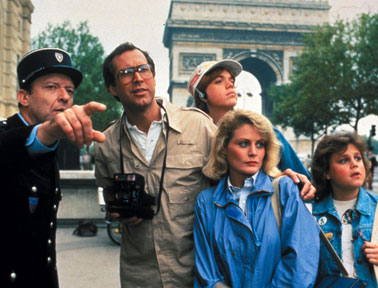
Caught a few seconds of the movie National Lampoons European Vacation and then looked at some Facebook pictures of a friend’s travel overseas. Interesting to see how we act when we are in a foreign location. Some of us become more conservative when in uncharted territory. We stay with the known and use the guide books and local knowledge as reference points. Others go adventure wild, perhaps feeling less inhibited around individuals that they are less likely to know or see in the future.

Where do we as organizations go to try new things? Do we have a way of testing new ideas while maintaining some form of control? How do we take time to review the way we have been doing business? How do we consider alternative views or different ways of looking at our assumptions?

In the April issue of Spirit (Southwest in-flight magazine) there is a one page interview with Stephen Covey. One quote he reflects on is from the president of Toyota who says the Detroit automakers “overemphasize marketing, design, and technology, but don’t focus enough on building a culture that makes people accountable to each other as a team, and not just a single figure.” This seems like a paradigm shift in corporate culture. How would you go about implementing this change, especially when the US automakers continue to try to design and market their way out of their failing business models?

How do we make sure we are looking at our organizations from multiple viewpoints?

10 Changes


Reading the Sunday NY Times and came across an article addressing the recalibration that charities with ties to Israel are undergoing. Some of this comes in reaction to the fraud perpetuate by Madoff, some by the deep reliance on American donors who are are changing their giving habit based on the economic recession. Clearly this issue has played out on a public stage but I believe the nonprofit sector is going to see 10 changes in reaction to the current environment:

1. Mergers: Those who no longer can perpetuate their mission are looking for strategic partners (and sometimes organizations that have the best balance sheets). The most requested books and articles in my consulting library are about mergers.

2. Bankruptcy: Who ever thought there would be a rash of bankruptcy filings by nonprofit organizations. Clearly financial reorganization has become a necessary option in some cases. What does filing bankruptcy say to your clients, funders, volunteers, staff, and community? People are too concerned to buy American automobiles because they don’t want to loose their warranty. Would you donate and advocate as actively for a nonprofit organization undergoing bankruptcy?

3. Going Out of Business: Complete termination of services. It use to be whispered about- now it is real and it is taking place more frequently than we realize. What holes is this leaving in the nonprofit sector?

4. Finance Committees: This responsibility was occasionally left to a small group with financial acumen and some boards simply rubber stamped the Financial Committee’s recommendations. I hear stories obout the board asking more questions, requesting additional training and financial reports that they can read and understand.

5. Conservative Budgets: Anyone approving a budget with wild revenue projections this year? Anyone spent a board meeting recalibrating this year’s budget to be in-line with reduced revenue expectations? Enough said.

6. Gala Fundraisiers: Special Events became the poster child for nonprofit fundraising in the past ten years. Auctions were everywhere. The ridiculously boring to the over-the-top versions. They were not unique in most cases, cost a lot of money and a ton of time to produce. Many auction established a transactional method of giving for donors. I give and I get. I believe a new strategy will take the place of special events. Many auctions are off 30-40% this year. Interestingly, the one part of the auction that is meeting budget: Fund-a-Needs (raise your paddle to support a program or purchase an item for the organization). Donors want their money to go towards the organization’s mission.

7. Reliance on Volunteers: The untold secret for many large nonprofit organizations was that the the Baby Boomers were retiring and going to swell the volunteer ranks. Guess what, many of these ‘volunteers’ have had to add years to their careers or are not looking for volunteer opportunities. This was a strategic initiative for may organizations and now they scrambling to adjust. What assumptions has your organization made?

8. Barter and In-Kind Gifts: More groups are seeking unique was to share resources, trade services, or offer creative arrangements. These collaborative efforts often avoid organizations paying cash for services when a trade can be worked out. I recently saw three local theater companies hold joint auditions for their community. One day, many roles, one locations. Seems like a good use of time.

9. Going Against Trends: It is trendy (and for may of us a necessity) to be thrifty right now. Very few donors are not going to attend an auction and spend money just to show-off. Individuals working for companies where layoffs are taking place are not about to be seen spending lots of money in public. You cannot beat the trend or public consciousness. Best to understand it and respect the public pulse.

10: Donor Demands: I have already seen organizations turn down donations with too many strings attached. The mantra for many organizations has become ‘annual operating support.’ Even the largest endowments are seen as vulnerable in these times. A dollar given today is much closer to par. If your organization raises $100,000 in annual support it would need $2 million in an endowment which would have been $3.4 million before the average portfolio dip of 30% endowment value. Unrestricted annual operating dollars are king.

Just ten basic changes that I think will germinate from this period. What changes are you making?