Consulting

Bringing in the Expert

I spent the last two days facilitating a strategic planning retreat with an educational client. There was lots of the dynamic conversation about the organization’s future. By chance, the president of the regional association representing educational institutions was in-town and attended the wrap-up session.

To gain a fresh perspective from an expert in the field has been transformative for the school’s planning efforts. To have an individual who could help focus the planning process was remarkable. One of the keys for the school in the planning effort was to be intentional in establishing its initiatives and not just select a goals that served as placeholders. The language that was being proposed for one of the outcomes bordered on cliche and the association president quickly helped us define the true intention.

Who could you invite to your planning sessions who can ask the critical questions? Who tests if you are being intentional? How do you avoid cliche language in your goals?

Being Empowered


Decoding and familiarizing yourself with a new place opens unseen paradigms. Our recent visit to Washington, DC reminded me of the importance of connecting with people and sharing your perspective. In meeting our local congressional staff and taking an amazing tour of the Capitol I regained an appreciation for the importance elected representation. It was a reminder that I have too have served as a guardian for the public’s trust on numerous occasions. I like to believe I have taken the assignments seriously and been effective in sharing my talents. What was enlightening to me was the fact that I rarely received input from the ‘public’ whose trust I was representing. Occasionally, the organization I was serving would stir-up some controversy and constituents would demand action. But mostly it took a focus group, specific invitation, or directed question to encourage feedback.

In the book Tribes Seth Godin reminds us of the importance of connecting with people, keeping it simple, encouraging members of the tribe to connect with each other. So I emailed my Senator with feedback on a piece of pending legislation becoming a more active member of the tribe.

How are your encouraging feedback from your donors, members, volunteers, clients, community?

Headlines & Outliers

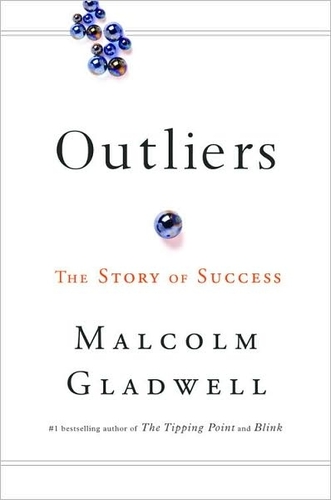
I really enjoyed reading Malcom Gladwell’s book Outliers and have commented on it previously. One of Malcom’s thesis relates to our birth date, talents, and the confluence of events that take place during our lifetime.

With so much taking place in the world right now, I wonder who is positioned to influence our direction? Which economist, lawmaker, financial mind, business leader, activist is prepared to lead during such a dramatic recession? What ‘wise captain of industry’ is making a fortune? What product is being revolutionized?

Who will influence Iran during what appears to be a potential tipping point?

How will the United States react if missiles are fired at Hawaii by an apparently hostile North Korea? Who will rise to the top with an initiative to shape a nation’s reaction? Will it be hostile or peaceful?

So many questions from the front page of the news. Think of the million of other initiatives and influences taking place today.

What opportunities are presenting themselves to you during this moment in time?

Society’s Role in the Fundraising Gala

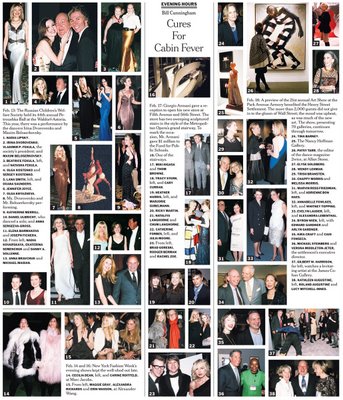
Catching-up with last week’s Sunday New York Times this morning and came across the Evening Hours page by Bill Cunningham. The column is a series of numbered pictures with captions identifying the individuals pictured and then a brief narrative about the charity being supported. Captured in the synopsis is the date of the event, location, number of guests and amount of money raised.

I interpret the column to be a combination of photo-journalism and society Facebook. I think it is tremendous that Mr. Cunningham provides coverage as there are many worthy causes. I also know that the presence of well know individuals is a way to draw readership for the NY Times and attention for the nonprofit organization.

What I wonder is why do we not see the same column for the people who volunteer? Why not highlight those who have given time, expertise or supported at a lower giving level but a meaningful percentage of their income? The fact that those who met a minimum giving requirement, dressed in appropriate attire, and secured an invitation are captured for visual presentation is a forum for a column. I am skeptical that everyone who attends truly understands the work the cause is addressing. Experience at other gala events would suggest that some guests are just there for the party. The narrative of what happens daily at these tremendous organizations would be a great hyperlink from this column. Use society and social standing to get my attention and then allow me to learn more. Get me to the organization’s website, tap me into the opportunities to support, provide a link for more information.

How are you optimizing media coverage to draw in new supporters?

A Beltway Observation

I have been in DC the past couple of days. Acting as a tourist, seeing the sights, and walking everywhere. It has been a great vacation with the family and now is time to head home. In spending a few days down the street from the White House I have noticed the few unique DC characteristics:

  • Everyone drives like they are in the Presidential motorcade. Lots of fast accelerations, lane switching, and horn honking (public substitution for sirens).
  • Black suburbans and SUVs are the ubiquitous. It appears to be the vehicle of power.
  • Suits and ties are everywhere. Sitting in the airport right now, I see more people dressed in business attire than just about any other airport I have traveled from recently.
  • Power lunches/dinners still exist. Every meal we ate in a restaurant seem to leave us eves-dropping on some discussion about legislation, the administration, or political gossip.
  • The presence of work ID badges: everyone seem to have a credential. From tourist sights to hotels to government. I was waiting to see a vendor who sold a fake version.
  • Blackberry’s seem to rule DC. The ratio of Blackberrys vs. iPhone is noticeable in the capital.

Interesting how one’s region has its own culture, habits, icons, and narratives. It was palpable.

What attributes does your community support (even at a sub-conscious level)?

Yield is what matters, and yield comes from getting through the Dip. You punch through the clutter when you allocate more resources and more dedication than everyone else (in that market). Ignore the other markets and the other channels. They’re dead to you anyway.” Seth Godin’s 6/12/09 blog entry

lancearmstrong

A quick example. Lance Armstrong has become universally available on Twitter. I can follow every details he chooses to share about his cycling career, family, LIVESTRONG Foundation, travels, music choices, etc. He is not trying to duplicate his posting on Facebook, My Space, You Tube with the same frequency. He has one million followers on Twitter who are willing to get information 140 characters at a time. This is a classic example of owning a market.

What market do you own? Do you try to cover too much (the shotgun approach). Be precise and own a market today!

Fear

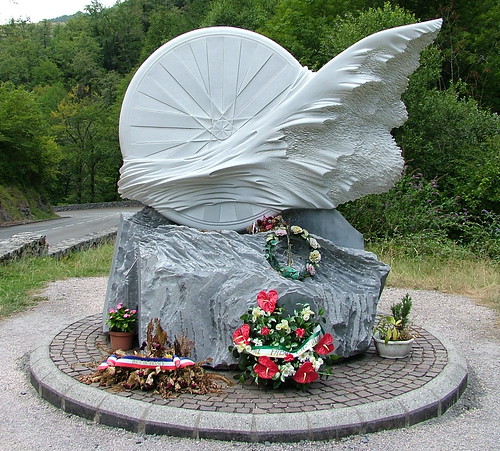
Our town has lost three cyclist during the past three weeks- all killed in accidents involving bike vs. vehicle. Today, I rode past the site of yesterday’s accident. I could feel fear jump my cycling spirit and try to scare it away. This is not the first time. I have vivid memories of getting back on my bike after having lost my father to a bike vs. car accident. A very distracted and drunk driver made a poor choice that day. It is personal but it is also about fear.

How many times have we as members of vibrant and successful organizations resisted an opportunity that may have taken our organization from very good to remarkable? Which donors did we fear to approach? Which person did we never get around to asking to volunteer? Are there partnerships we fear to enter into? Do we have programs, staff, volunteers that we must let go? Is there an elephant sitting in the room that everyone ignores?

Many times it is fear that holds us back from taking a calculated risk. I am certain my father would gladly have taken any of the training rides I took this week. I am certain that the latest cycling victim would have desired one more- if not a lifetime of bike rides. So I cannot succumb to fear and I head to road again. I hope that my faith in the ability and attention of the others that I share the road with will be rewarded. I cannot let my enjoyment of riding be diminished by fear. What I saw today during three and half-hours of riding was remarkable in itself and I am better for the adventure.

What happens when we commit to our talents and do not let fear hold us back?

Taking Your Skill On The Road

Drove out of a Lowe’s parking lot yesterday and saw two gentlemen standing in front of a van with the doors opened and a variety of specialty tools laid out in front of the van. Cardboard signs read “Skilled Carpenters- Need Work- Rate Negotiable.” I passed the van on three sides and clearly these individuals had all the tools one would expected of a competent carpenter.

How do we advertise our skills in the community? What is the marketplace for our labor and expertise? Clearly these individuals had decided that the parking lot at Lowe’s increased their probability of securing a job. Had they been standing in the parking lot with just a sign, I would have not have taken as much notice. The fact that they had their vehicle, the tools of the trade, a sign willing to offer references, and motivation made their presence more remarkable.

I have receive calls from people interested in working as Executive Directors with no previous nonprofit experience but plenty of corporate leadership, individuals interested in serving as the member of a board, volunteers just looking to use their specific skills. I am quite certain their is a position for each one of them. They call me because they hope that my role as consultant will advance them to the front door of the nonprofit super store where they can walk-in and find the position they are seeking. Sometimes I have potential leads and sometimes I do not.

Word of mouth is valuable. Being in the right place is even better. I wonder what the right place is for talent in the nonprofit sector?