![]() |
| Seth Godin |
Seth Godin
Are You Connecting or Collecting Dots?
Transform education by ask: What is school for?
Inside vs Outside
Two frequent approaches to creative thinking. One is to think outside the box. The other is to push at the edges (hat tip Seth Godin). Thinking outside the box requires a lot of trust and a willingness to abandon the current platform. Pushing at the edges starts from a known point and expands outwards. Both are powerful and offer remarkable results. Knowing when to employ each one is critical.
Sleuthing and the Golden Circle
![]() |
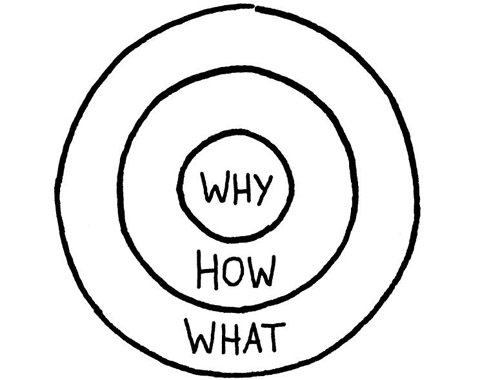
| Simon Sinek’s Golden Circle |
I had the pleasure to present to a class of students working in or preparing to join the nonprofit sector. A question was posed about how to understand an organization’s “why” if the nonprofit cannot articulate their belief. After providing my best on the spot answer I thought more about how to decode an enterprise’s “why”. Here are some strategies that have served me:
- Most organizations have immense amounts of literature, online content, and stories about “what” they do. They can tell you every program, service, and metric. This is low hanging fruit and easy to slot into the “what” portion of the Golden Circle.
- The sleuthing begins when you unpack the organization’s “how.” Begin by asking what values are important to an organization when they select a program or service? How do they deliver their services? What is the organization’s hallmark? Why? What people do they hire to join the team and why? How does their Help Wanted sign read? How are they uniquely positioned to fulfill their mission? Somewhere in these questions one will begin to assemble the “how.” Remember that “how” is not tangible, instead it is commitments to maximizing a cause’s purpose.
- The “why” may appear a void but these shortcuts may help. Ask why the cause was founded. What problem or opportunity was the founder trying to impact and address? Founders are amazingly coherent when articulating the purpose of an organization. Ask the founding story or what the early years were like at the cause. Consider a query about the organization’s current signature event/program? You can even use the Seth Godin approach and ask if one were to describe the organization’s greatest super power, what would it be? Lastly, you can always ask the Chief Executive or most visionary employee why they chose to join the cause? What do they believe that the organization amplifies?
Are You Part of the No Coalition?
![]() |
| Credit |
What else do we need to know so we can say ‘yes’ was the question from the back of the room. Heads turned and the most silent of the meeting’s participants had just thrown us all out of the proverbial express boat to the island of No. It was a brillant question and it completely energized the staff and supporters of the proposal. Seconds later sheets of paper were filled with ideas from an immediate brainstorming session. Obstacles and objections were identified as well as strengths and new points of confluence with on-going initiatives. With one question the meeting had come to life, ideas were being shared, engagement was soaring, and camaraderie was building. It is easy to identify one way to say no. The real talent is discovering strategies that let you say yes.
Seth Godin’s post illustrates the defused power of no with perfection. I am glad to have seen the collation of no battled in the arena of institutional habits.
Education Manifesto
![]() |
| Credit |
If you wish to read one piece on transformative ideas in education I highly recommend Seth Godin’s manifesto which he released this week. I am attending the National Association of Independent School’s conference and will be interested to hear the reaction to the ideas Seth has advocated, starting with Bill Gates’s opening keynote.
A sample of Seth’s manifesto:
84. The two pillars of a future-proof education:
Teach kids how to lead
Help them learn how to solve interesting problems
Leadership is the most important trait for players in the connected revolution. Leadership involves initiative, and in the connected world, nothing happens until you step up and begin, until you start driving without a clear map.
And as the world changes ever faster, we don’t reward people who can slavishly follow yesterday’s instructions. All of the value to the individual (and to the society she belongs to) goes to the individual who can draw a new map, who can solve a problem that didn’t even exist yesterday.
Hence the question I ask to every teacher who reads from her notes, to every teacher who demands rote memorization, and to every teacher who comes at schooling from a posture of power: Are you delivering these two precious gifts to our children? Will the next generation know more facts than we do, or will it be equipped to connect with data, and turn that data into information and leadership and progress?
Customers
Seth Godin often says the things I have been thinking and trying to articulate. He does so with just the right words and illustrations. Seth’s observations about customers are precise. As Seth asks, which statue are you building?
Willing to Fail
![]() |
| Credit |
‘Tis the season to receive glowing reports of the numerous successes in the social sector. The End-of-the-Year Appeal letters go to great lengths to define the impact of the cause. Online video cards arrive in our email inbox with emotional recounting of the organization’s highlights. It is all about feel good and reconnecting to the best an enterprise has to offer.
Why do so few causes acknowledge the failures and the lessons learned? Is there a fear of being authentic? Is the appeal being sent to those who are less than committed and may want off the cruise at the first sense that the ship sailed into a storm? Why not talk about the ‘oops’ moments. If you are an in athletics many a failure is catalogued in real-time and the competitor is asked to explain the event immediately after the competition. These incidents are not to be avoided. In my experience the social sector prefers to run the highlight real constantly. We are taught that it is our elevator pitch. It is easy and everyone feels good. But I wonder why we are not willing to standout and share the real story of the organization’s year. Tell the story of the summits reached and the journey in the valley of disorientation. As always, Seth Godin has masterfully defined the difference between a failure and mistake . His definition provides a powerful template for future communications. I wish you much success is telling your enterprises real story.
Your Purpose
![]() |
| CosmoCaixa |
Seth Godin got it right in his post. We each have a purpose and sometimes it take the right problem to bring the clarity we need to start applying our best ideas.