Rory’s talk is terrific and provides an inspiring context to view current events. If the state of foreign affairs is more than you want to wrap your mind around, skip ahead to the 16:00 mark for a tremendous metaphor.
Innovative Concepts
Transactional vs Treasure
A great organization that I support just wrapped-up an online auction. Their experience seems to confirm what I always suspect, auction items that can be readily purchased outside of the auction typically lead to transactional bidding patterns. Meaning individuals will bid as long as they perceive that they are helping the cause and getting a deal. It is hard to inspire transformational giving through a computer screen. Here is a sampling of the results from an online auction.

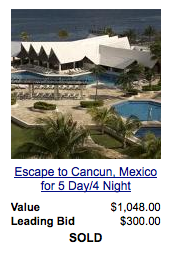

As you can see, the Boise State Football tickets went for slightly more than valued. The Escape to Cancun winning bid was at one-third of the estimated value. Finally, the stay in Antigua received no bids. The majority of the items in the online auctions that I have reviewed tend to fall into the middle range. Winning bids are 30-60% of the estimated auction item’s value. What does this mean? The bidder gets a deal but in reality they are technically not making a donation since their bid did not exceed the item’s estimated value, meaning there is no tax-deduction for the transaction (not a legal opinion). The nonprofit gets a portion of the proceeds but pays the online auction company for the software or an annual fee plus a percentage of the proceeds (starting near 10%) of the auction’s gross. Lastly, somebody donated the item and they hope to see the maximum value gained for their donation. If their item goes for a huge discount the feeling of success and appreciation is easily diminished.
How do you maximize an online auction? Blend the value of the auction items so they mix a commodity with an experience that is challenging to replicate. A coffee card for $50 is fine but it is rarely going to generate its value. When you consider the time and effort that went into securing the gift card and then the resources required to register the item, the return on investment is limited. So what if you take the coffee card and include an invitation to have coffee with the founder of the cause? Or the mayor of the town? Or a celebrity? Suddenly supporters are bidding on an experience and get a coffee card on the side. Items that are perceived as commodities get treated as such. Experiences that offer a chance to connect with what somebody believes are regarded as treasure.
Moving Up the Mountain

Ski lifts, gondolas, and funiculars only work if they bring a skier or snowboarder far enough up the ski hill so they can ski down to the next lift which takes them higher. Simple enough to design. The same principle is relevant when trying to engage fans and donors. These individuals who are test commitment need to travel far enough up the mountain that they can easily transfer to the next level. If you unload them in the middle of nowhere after an initial inquiry or contribution most are not going to head any higher. However, if you provide a map, offer assistance, and help them see the same view that inspires you, the chances of success are much higher.
Do your ski lifts connect?
Tell or Show
Repackaging Knowledge
Swapping Places

If your enterprise could swap physical locations with another business or cause, who would you select and why?
Strangers

I appreciate the post by Seth Godin today who discusses the dangers of relying on strangers to fuel your enterprise. It reminds me of social sector organizations that are willing to invest significant organizational time and resources chasing grants from foundations and federal enterprises which they have no connection instead of speaking to their committed fans. It is far easier to pin ones hopes to the unknown since the personal risk is minimal but the greatest reward comes from asking the most committed to increase their contribution. Typically those who deeply support your cause are willing to think about transformational gifts versus an entity that does not run on emotion but rather measures it progress based on criteria and a mandate. Where are you spending your time?
Big Fish

There is a great philosophy presented Lama Surya Das in his book, Buddha Standard Time. He speaks about the importance of not keeping each fish you catch metaphorically, but holding onto the big fish that you truly seek. Would you recognize the big fish you are seeking if you caught it? Are you easily distracted but whatever pulls on your line?
“The little fish are our momentary desires, ambitions, and goals: fortune, fame, pleasure, comfort, and other fleeting experiences. None of these can last. Yet we cling to them as if they will endure forever. The big fish is finding our eternal dream. Too many people fail to find the overarching purpose of their lives.” -Lama Surya Das
Your In or Your Out

Trip to Disney World or Disneyland- are you in or out? Most people can make that decision in a second. Why? Because Disney has defined what they stand for better than most organizations. There are those who have their mouse ears on and already update their Google+ status. Others would be halfway into their, ‘you would not catch me in a Disney park if I was dead’ speech. No judgement on your reaction but this is a perfect example of an enterprise that has defined its purpose. Most people know what they think already. Does your community react the same way to your cause? Do you know who is in or out?
For those who are undecided, here is a link to three behind the scenes tours that Guy Kawasaki took recently: Disneyland Dream Suite, Club 33, and Walt Disney’s Apartment. If you are clicking the links you are probably in.
Context

I read an article that asked the interviewee for a wish. The respondent said that they wished, ‘a different political party was in control of congress in Washington, DC.’ A wish that probably resonates with half the population at any moment in time. The issue is that the comment was made before the last congressional elections and the political leadership has switched parties. Now the statement reads differently than intended. Had the interviewee been specific and said which party they wished to see in power then the meaning would have weathered current events with a little more grace. Context is important. Painting a detailed picture about what you believe typically lasts longer than a vague suggestion.
 What-if-concepts