The Difference Between Dreams and Goals

Something special in July

Swiss World Champion and current Tour de France yellow jersey wearer (awarded to the leader of the race after each stage), Fabian Cancellara responded to a question about his chances of winning the three-week stage race, “I’ve already said many times about the Tour that winning it is a dream and not a goal.  Those are two different things.  That’s why winning the Tour will always remain a dream for me.  I won’t work for a dream.  I have goals and there are some big classic races that I still want to win, and those goals are possible.’  It is essential to maintain clarity about one’s desired destination otherwise every intersection requires a pause or a full stop to evaluate the options and in the sport of cycling this would mean never winning a race.  


Do you have clarity about the outcome you have selected?  Are you focused and committed to reach it?  If not, then a few days in ta yellow jersey may offer a temptation to change the destination.  Exchanging the greater goal for immediate success and victory eliminates some unknowns and reduces fear of failure.  Why not take the champagne and flowers awarded to the winner?  This does not mean abandoning opportunities that present themselves in the course of pursuing the great goal.  Cancellara is going to defend the yellow jersey as best he can but he is realistic about the type of training and focus it would take to be a true contender in the Tour.  When the race reaches the mountains tomorrow there is good chance the maillot jaune will slip from his shoulders but it will have been in pursuit of something greater.


Are you pursing dreams or goals?

Too Big to Behave

Too Big to Fail?

BBC radio interviewed a past member of the British Government speaking about the failure of leadership at Barclay’s bank.  At a recent panel discussion the former official said the financial sector had moved from “too big to fail” to “too big to behave.”  This sentiment caught my attention.  How often has social sector scandal erupted when an organization or an individual became too powerful and suddenly common sense and regulation were tossed aside to keep a ‘good thing going?’


If you have assembled a committed group of followers they will be quick to reenforce and remind leadership of the group’s values.  If the group’s point of intersection with organization purpose is unclear there is a vast frontier of possible values.  The lawless western town becomes run by those that can manipulate the community and too big to behave is the lowest common denominator.


How do we ensure that we are creating tribes that have clear points of confluence and commitments?


If We Win- I Am In

If I ask you to envision a chair, what do you see?  How about an elephant?  Now, what do you see when I mention youth education program?


Here is my anxiety about trying to connect with individuals using features and benefits as the primary point of intersection.  Taking the elephant example, you may have pictured an adult elephant standing in a zoo enclosure.  For someone else they see a young juvenile running in the African savanna.  Another image may be of a purple elephant dancing.  Additional renditions might include an ivory tusk sitting on bookshelf in a study. How about the whole cartoon depiction of elephants?

Favorite cartoon elephant is?

  When you talk about a service or program as an introduction to your organization’s work, odds are high that the person listening has a very different picture in their mind than the one you are trying to articulate.  However, when we start by talking about what we believe, that brings a strong emotional response that offeres an authentic point of intersection.  It is not deceptive or misleading since belief is one that resonates powerfully for both parties.  Programs and services change over time.  They can easily inspire and disappoint at the same time.  Beliefs stay true if the actions you take to manifest them are consistent.


I would highly favor identifying a point of connection around a shared belief than feature.  Ask any sports team that builds a fan base while winning and then watched it crumble when they endures losing seasons.  The true believers continued to come to the games because the shared a connection that was not defined by a win-lose record.

Billboard Tribes

Do you need a membership card to define your tribe?

Billboards are great place to connect with your customers if you are ready to sell limited-time features and offer a short-term opportunities.  Loyalty programs are designed to build a tribe based on transactions.  If United Airlines were to terminate its MileagePlus program I would start my airline reservation search by lowest fare instead of by airline preference.  Why? I am passionate about my mileage balance and frequent flyer status which bring certain rewards.  It is not because I am not loyal to United, they have trained me to care about transactions, not the tribe.


When we try to develop loyalty through transactions we are building a house of cards.  True loyalty is demonstrated by those who would miss you and your super power if you were not around to share it (to paraphrase Seth Godin).  Convenience loyalty is cultivated by possessing something of temporary value that keeps people in the general vicinity.


Who would miss you if you were to stop performing?  That is your tribe, everyone else is less deeply connected.  They may be ready to join or are just hoping to get something in exchange for their proximity.  Make sure you treasure those who notice your arrival and departure.    


What is Your Super Power?

I like this video because if the kite surfer was able to listen in on the commentary of the people filming he/she would be overwhelmed with suggestions and anxiety.  Instead the kite surfer knew his super power and went about performing unencumbered by the doubters.  Once he clears the pier the classic line is uttered, “he is obviously a professional.”  Why were we doubting him in the first place then?


Who do you listen to when your super power is in full display?  Do doubters keep you from sharing your best? 

Not for Everyone

The Disney Wonder

I recently met Zaldy, a man who was employed as a server in the restaurants onboard the Disney Wonder cruise ship.  The Disney Wonder and its sister the Disney Magic have been in operation since the late 90’s.  Disney Cruise Lines recently added the Dream and are launching the Fantasy to their line-up.  The two new ships are 40% larger and have numerous upgraded amenities.  Zaldy mentioned that two of his co-workers transferred to work on the new ship.  Both returned to the Wonder when their contracts renewed.  I inquired why and he said the Wonder had established a vibrant community of co-workers who resembled an at-sea family.  Most of the employees sign four to six month contracts and then re-commit for another contract after a couple months at-home.  Numerous crew members have families at home who rely heavily on the income generated via Disney Cruises.  The camaraderie and connections could not be manufactured instantly in the new ships.  And the scale of the ship created its own challenges.  One of Zaldy’s co-workers said that it took her 5-7 minutes to get to her post at the restaurant each day on the Wonder.  However, on the Dream the transfer time was twenty minutes.  Even at-sea, a commute can be a quality of life decision.


Perhaps the greatest lesson from my interaction with Zaldy was that newer, bigger, and flashier does not mean better.  A core group of crew member on the Disney Wonder have been there for years.  They have created a community and network.  You cannot instantly manifest a tribe from 1,500 new crew members on a ship no matter how magnificent.  It takes time to build a tribe, members come and go and through the process of rotation the core is defined.  


Make sure to celebrate the tribe and not get overly focused on the features and amenities.

To Squeeze?

Ready?

I have been following an online forum about maximizing philanthropic opportunities.  The majority of the chat participants were advocating for the squeeze approach when it came to securing a contribution with a potential donor.  The group-think was to get as much as possible from a single interaction.


On a parallel tract I witnessed a number of individual take action to support a cause because there was a sudden need.  No call to action was made, the organization just shared a current challenge they were facing as part of their pledge to be transparent.  The enterprise had not even developed a strategy to address the headwind that was now challenging their ability to stay at speed.  Fans of the cause saw an opportunity to offer assistance at a critical juncture.


Both of these approaches yield results.  The first requires more leverage and manipulation which leaves the donor feeling squeezed.  The second is inspired by a shared belief.  It is powerful and repeatable.


The question, what type of relationship are you cultivating with your tribe?

Sleuthing and the Golden Circle

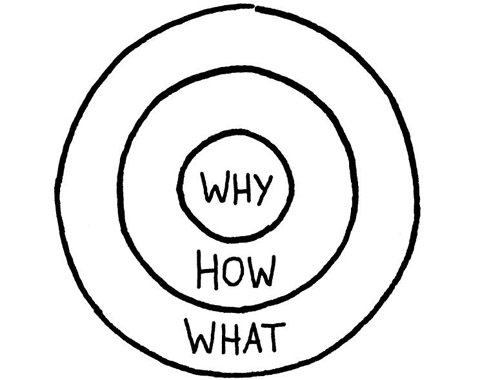
Simon Sinek’s Golden Circle

I had the pleasure to present to a class of students working in or preparing to join the nonprofit sector.  A question was posed about how to understand an organization’s “why” if the nonprofit cannot articulate their belief.  After providing my best on the spot answer I thought more about how to decode an enterprise’s “why”.  Here are some strategies that have served me:

  • Most organizations have immense amounts of literature, online content, and stories about “what” they do.  They can tell you every program, service, and metric.  This is low hanging fruit and easy to slot into the “what” portion of the Golden Circle.
  • The sleuthing begins when you unpack the organization’s “how.”  Begin by asking what values are important to an organization when they select a program or service?  How do they deliver their services? What is the organization’s hallmark?  Why?  What people do they hire to join the team and why?  How does their Help Wanted sign read?  How are they uniquely positioned to fulfill their mission?  Somewhere in these questions one will begin to assemble the “how.”  Remember that “how” is not tangible, instead it is commitments to maximizing a cause’s purpose.
  • The “why” may appear a void but these shortcuts may help.  Ask why the cause was founded.  What problem or opportunity was the founder trying to impact and address?  Founders are amazingly coherent when articulating the purpose of an organization.  Ask the founding story or what the early years were like at the cause.  Consider a query about the organization’s current signature event/program?  You can even use the Seth Godin approach and ask if one were to describe the organization’s greatest super power, what would it be? Lastly, you can always ask the Chief Executive or most visionary employee why they chose to join the cause?  What do they believe that the organization amplifies?
The cause may not be ready to discuss its “why” but with some leading questions one should be able to assemble enough information to understand the enterprise’s purpose.

What question’s do you ask to get to “why”?