The People in the Room

Listened to a Fresh Air interview with Adam Liptak. Adam was asked for his observations while covering the Supreme Court for the past year on behalf of the NY Times. He had some interesting perspectives of the recent year and the decisions rendered by the justices. Perhaps most revealing to me was his comment about how the cultural and gender make-up of the justices in the room has changed the conversations that take place in the court. Having an African-American, woman, or minority as a justice changed the tone, tenor, and process of deliberation. Adam argues that just by their presence, even before you get to their intellectual and legal input, the decision-making process was altered by the make-up of the people in the room.

“Diverse inputs make for better outputs” is one quote Adam Liptak sites during the interview.

This is perhaps a great reminder to be intentional about who we include on our boards, strategic planning sessions, decision-making moments. Diversity has power, especially when it comes to deliberating about tough decisions.

Taking Ownership of Planning

My children created a list of all the summer activities they want to complete during summer vacation. Their list is ambitious, creative, and humorous. As we accomplish different adventures they take turns taking the post-it notes off our ‘Summer Adventure’ poster board. It has been a rewarding experience to see them take ownership of what we do this summer. They have planned the events, prioritized, participated, and celebrated each event’s successful conclusion.

How does your organization create a culture where the board and staff have appropriate influence over the planning, execution, and celebration? What if you had post-its that you removed after the big milestones were passed? How do you create a shared experience?

Now how to get to Paris, France (as requested by my son)?

Spokesperson


Attended the Jonas Brothers concert with my daughter the other night. It was loud, mostly the screaming and then the music. It clearly met the expectations of the young pre-teen and teenage audience judging by the shrieking, texting, photographing, dancing and swinging of glow sticks. This was my first venture into the teenage concert scene and it was memorable.

Nick Jonas (as I was informed by my daughter) took a moment in the middle of the concert to give a personal account of his struggle with diabetes. He played the piano in the middle of the elaborate stage set-up and recounted his journey. For a few minutes the crowd was quiet and listened to his story. The brothers are selling a dog tag at their concerts (http://www.daily-diabetic.com/50226711/nick_jonas_diabetes_dog_tags_to_raise_funds_for_jonas_brothers_foundation.php) as a fundraiser for diabetes support. The dog tags are the equivalent of the LIVESTRONG wristband.

By giving a personal account of his struggles the concert goers seem to take the story as genuine. I believe if Nick had been representing a cause that had not touched him personally his fans would have been less attentive and not as willing to invest in the dog tags.

Who can best communicate the cause your organization is meeting? Are they authentic? Are they passionate? Does the audience trust them?

Outsourcing


Packing the large camping cooler this morning and I realized that the plug for the drain was missing. I looked around for the missing piece and then quickly realized I needed to create a substitute. My children had just spent the last week at a summer invention camp so I figured that I would tap their inspired minds for a solution. Before I could finish showing them my problem, one produced leftover foam earplugs from the Jonas Brothers concert the evening before, the other one was grabbing some plastic and a rubber band. They handed me their contributions, recommend adding some tape and then went back to whatever they had been playing prior to my interruption.

Sometimes outsourcing works and saves a lot of time. Which outside resources do you engage?

A Fine Bottle of Wine

I was a presenter at a conference focused on nonprofits and foundations yesterday. My good friend Mark at ClearRock Capital has been a great advocate to the nonprofit sector and hosted this event for years. I always learn something from the other presenters and appreciate the opportunity to create a fun and dynamic presentation (at least my perception).

As I drove home from the conference I started thinking about how to enhance my presentation. I started thinking about the challenge of creating a mission statement, I reflected on how challenging this process is for most organizations. How does an organization state what cause it meets and yet make it inspiring? I started thinking about the marketing on a bottle of wine. If you read the label on many bottles of wine they tell you that it not only contains a specific varietal of wine but also goes to lengths to describe the wine in unique and juicy adjectives. Some labels also add descriptions about the vineyard, proprietor and wine maker. The rich details makes you want to uncork and sample the ‘art’ inside (because the description has made you realized that it is far more than just grape juice).

What language do you have to describe your organization’s work? Is it as appealing as a good bottle of wine? Do people naturally ask you to tell them more? Have you engaged the right people to tell your story?

Cheers!

Bringing in the Expert

I spent the last two days facilitating a strategic planning retreat with an educational client. There was lots of the dynamic conversation about the organization’s future. By chance, the president of the regional association representing educational institutions was in-town and attended the wrap-up session.

To gain a fresh perspective from an expert in the field has been transformative for the school’s planning efforts. To have an individual who could help focus the planning process was remarkable. One of the keys for the school in the planning effort was to be intentional in establishing its initiatives and not just select a goals that served as placeholders. The language that was being proposed for one of the outcomes bordered on cliche and the association president quickly helped us define the true intention.

Who could you invite to your planning sessions who can ask the critical questions? Who tests if you are being intentional? How do you avoid cliche language in your goals?

Being Empowered


Decoding and familiarizing yourself with a new place opens unseen paradigms. Our recent visit to Washington, DC reminded me of the importance of connecting with people and sharing your perspective. In meeting our local congressional staff and taking an amazing tour of the Capitol I regained an appreciation for the importance elected representation. It was a reminder that I have too have served as a guardian for the public’s trust on numerous occasions. I like to believe I have taken the assignments seriously and been effective in sharing my talents. What was enlightening to me was the fact that I rarely received input from the ‘public’ whose trust I was representing. Occasionally, the organization I was serving would stir-up some controversy and constituents would demand action. But mostly it took a focus group, specific invitation, or directed question to encourage feedback.

In the book Tribes Seth Godin reminds us of the importance of connecting with people, keeping it simple, encouraging members of the tribe to connect with each other. So I emailed my Senator with feedback on a piece of pending legislation becoming a more active member of the tribe.

How are your encouraging feedback from your donors, members, volunteers, clients, community?

Headlines & Outliers

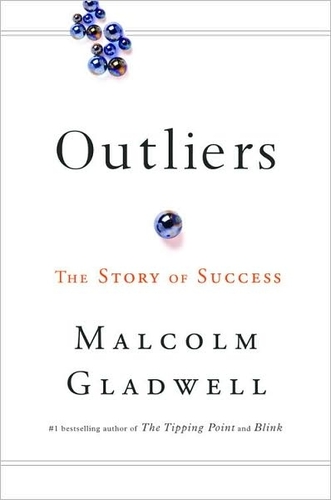
I really enjoyed reading Malcom Gladwell’s book Outliers and have commented on it previously. One of Malcom’s thesis relates to our birth date, talents, and the confluence of events that take place during our lifetime.

With so much taking place in the world right now, I wonder who is positioned to influence our direction? Which economist, lawmaker, financial mind, business leader, activist is prepared to lead during such a dramatic recession? What ‘wise captain of industry’ is making a fortune? What product is being revolutionized?

Who will influence Iran during what appears to be a potential tipping point?

How will the United States react if missiles are fired at Hawaii by an apparently hostile North Korea? Who will rise to the top with an initiative to shape a nation’s reaction? Will it be hostile or peaceful?

So many questions from the front page of the news. Think of the million of other initiatives and influences taking place today.

What opportunities are presenting themselves to you during this moment in time?

Society’s Role in the Fundraising Gala

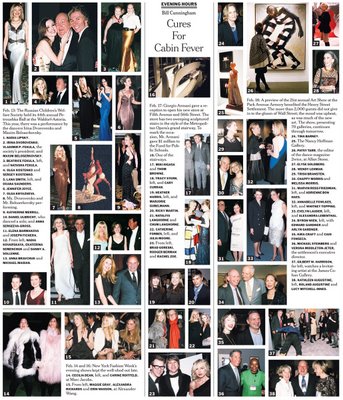
Catching-up with last week’s Sunday New York Times this morning and came across the Evening Hours page by Bill Cunningham. The column is a series of numbered pictures with captions identifying the individuals pictured and then a brief narrative about the charity being supported. Captured in the synopsis is the date of the event, location, number of guests and amount of money raised.

I interpret the column to be a combination of photo-journalism and society Facebook. I think it is tremendous that Mr. Cunningham provides coverage as there are many worthy causes. I also know that the presence of well know individuals is a way to draw readership for the NY Times and attention for the nonprofit organization.

What I wonder is why do we not see the same column for the people who volunteer? Why not highlight those who have given time, expertise or supported at a lower giving level but a meaningful percentage of their income? The fact that those who met a minimum giving requirement, dressed in appropriate attire, and secured an invitation are captured for visual presentation is a forum for a column. I am skeptical that everyone who attends truly understands the work the cause is addressing. Experience at other gala events would suggest that some guests are just there for the party. The narrative of what happens daily at these tremendous organizations would be a great hyperlink from this column. Use society and social standing to get my attention and then allow me to learn more. Get me to the organization’s website, tap me into the opportunities to support, provide a link for more information.

How are you optimizing media coverage to draw in new supporters?

A Beltway Observation

I have been in DC the past couple of days. Acting as a tourist, seeing the sights, and walking everywhere. It has been a great vacation with the family and now is time to head home. In spending a few days down the street from the White House I have noticed the few unique DC characteristics:

  • Everyone drives like they are in the Presidential motorcade. Lots of fast accelerations, lane switching, and horn honking (public substitution for sirens).
  • Black suburbans and SUVs are the ubiquitous. It appears to be the vehicle of power.
  • Suits and ties are everywhere. Sitting in the airport right now, I see more people dressed in business attire than just about any other airport I have traveled from recently.
  • Power lunches/dinners still exist. Every meal we ate in a restaurant seem to leave us eves-dropping on some discussion about legislation, the administration, or political gossip.
  • The presence of work ID badges: everyone seem to have a credential. From tourist sights to hotels to government. I was waiting to see a vendor who sold a fake version.
  • Blackberry’s seem to rule DC. The ratio of Blackberrys vs. iPhone is noticeable in the capital.

Interesting how one’s region has its own culture, habits, icons, and narratives. It was palpable.

What attributes does your community support (even at a sub-conscious level)?