Author: whatifconcepts

Empowering those that inspire so they can excel at the work that matters.

The Gift of Apprenticeships

One of the greatest gifts each of us can offer is an apprenticeship to somebody inspired by our art.  Not an internship that is limited to low-level job assignments and the hope that the intern absorbs the culture by osmosis.  Rather, a dedicated opportunity to amplify a passion; to be granted hands on opportunities and game time exposure.  

As a former Emergency Medical Technician, no amount of training on a simulator manikin could prepare me for a call.  Training helped me familiarize myself with the equipment and procedures but inevitably an actually response challenged all my assumptions.  Driving snowstorm, language barriers, combative patients, and precarious locations all needed to be experienced.  Medical emergencies seemed destine to happen in the most challenging settings.   Only with repeated opportunities to respond did my skill set improve.

Consider that many business schools are now foregoing theoretical case studies in place of apprenticeships with companies.  The theory is that the MBA students will work on actual projects that benefit the company and a performance stepping-stone when they graduate.  An apprenticeship offers an applicant a dramatically different answer to the question, ‘what experience do you have?’

When we reflect on our journey there are people we learned significantly more from than others.  Many of those individuals were enthusiastic enough to offer us spot on the stage to experience the spotlight and a real audience.


New

I walked past an airport kiosk selling Bose headphones and speakers.  A “new” sign hung under one item.  The Bose representative sat in a chair fully immersed in an ebook.  Metallica blared from the speakers.  The music and “new” sign were going to be responsible for any sales today.  The salesperson was too caught-up in something more important.

Branding an item as new does not mean people with spring into action.  We must connect and provide significance before real and meaningful interactions can take place.

Purpose vs Fame & Money

Calvin and Hobbes animation

Bill Watterson, creator and chief philosopher of Calvin and Hobbes fame is a remarkable example of staying aligned with ones purpose.  He ended artistic production of his comic strip at the pinnacle, pole position in the funny section in every newspapers.  He wished to control the future of his art and its application.  His followers were shocked.  It was as if the sitcom Seinfeld called it a career after season five and had foregone syndication.  Bill’s work on Calvin and Hobbes continues to be a source of inspiration, finding itself the thread that weaves together life’s lessons

Bill’s recent interview with Mental_Floss is illuminating.  The upcoming movie Dear Mr. Watterson, scheduled for release on November 15, 2013 should continue to expand the adventure.

Most inspiring is the care with which Bill took to stay true to his beliefs.  The money and fame were growing exponentially yet he chose purpose and that made his art even more precious.

Banksy

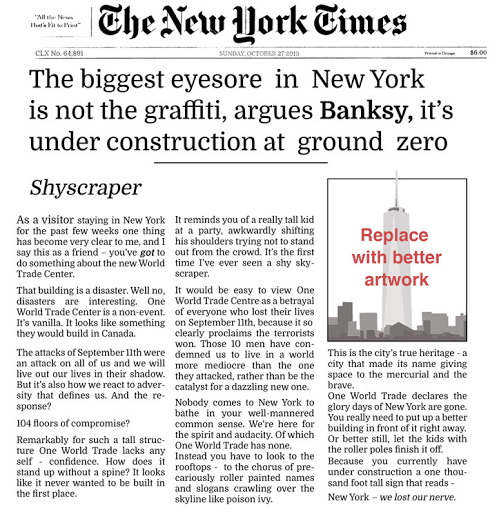
Authenticity is saying what one believes and then acting in a manner that is consistent and oriented to the stated belief.  Banksy’s residency in New York has taken on social and moral issues that are too sacred to discuss publicly.  His art will fade from the walls and temporary exhibition spaces, but the narrative he has encouraged will last far longer.
What is the narrative that takes place when the audience leaves the theater after viewing your masterpiece?

Disruptive

Does an idea have to be disruptive to be remarkable?  Said differently, does a new concept have to shake our conventional assumptions sufficiently to the point that we must comment?  Is disruption always progress?  

Apple released a new and enhanced line of products this week.  The reviews I read focus on how disruptive the new features and design are to the consumer’s current experience.  This form of disruption is deemed as positive.  Consumers were generally satisfied with the current model but now the new versions offers innovation worthy disrupting our habits and considering change.  

When I travel and the TSA changes a security screening procedure, disruption can be challenging.  I memorize the routine as a frequent flier.  I recognize that shoes are placed into a bin on the x-ray belt but suddenly they needed to be placed directly onto belt without a bin.  This form of disruption is unsettling.  Perhaps it leads to greater efficiency or more effective screening but it also can be frustrating.

Knowing what is and what is not worthy of disruption reinforces or erodes trust and loyalty.  Remarkable is not always great.  If you build a tribe of followers who share a core belief they will endure disruptions as long as it enhances the organization’s dreams.

Stories or Awards

Awards are secondary to the stories behind the experience of competing.  A ribbon can be worthy of an epic tale of achievement that lasts far longer than any plaque or trophy.  Customized or scarce awards make the story even more potent.  The finish line and post event party are full of people telling tales.  The winner’s accomplishments are often well documented but every competitor has an opportunity to share in the narrative.

Host an event and make it remarkable.  The stories that follow will be far more valuable than awards and goody bags. 

Hero’s Journey

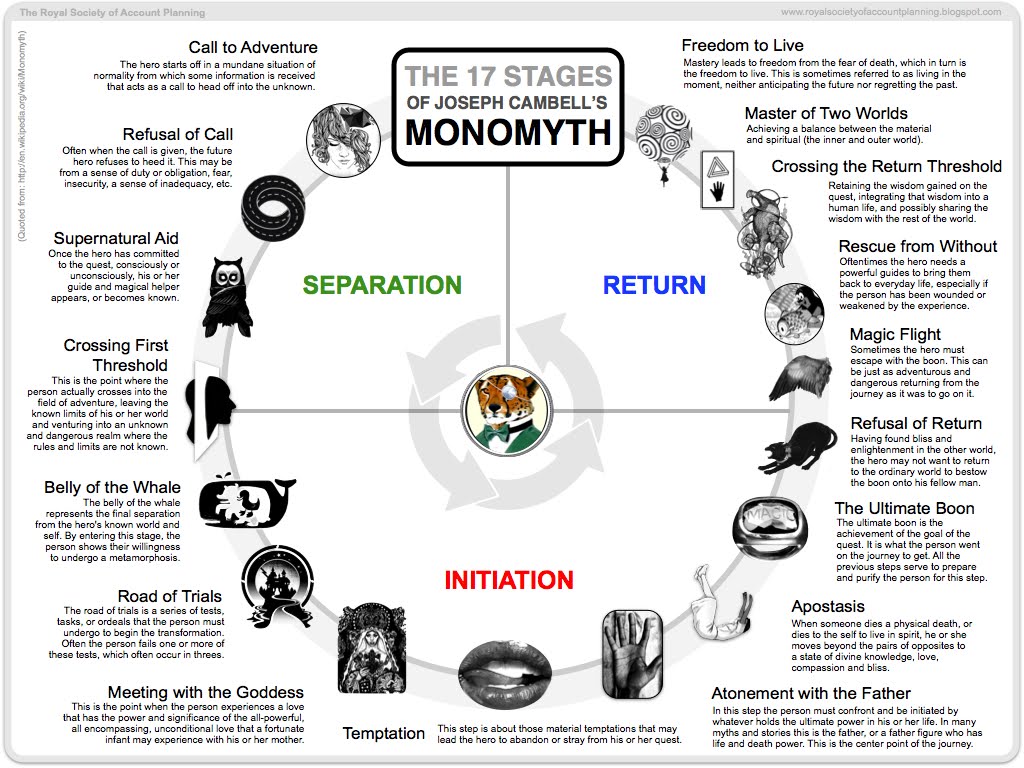
Summer camp, boarding school, new travel destinations, and numerous lifetime adventures are uniquely positioned to support the Hero’s Journey as developed by Joseph Cambell.  If we measure the impact of our lives by the stories we tell, then let us seek out remarkable quests.
How does a sleep-away summer camp experience amplify the Hero’s Journey?  A camper experiences an immediate separation from home.  The camper face numerous challenges, adventures and experiences.  An initiation or ceremony reveals their new talents and the camper return to the camp community and later home.  Forever changed the heroic journey is embedded in their story.  They may return to the summer camp for a succession of adventure programs, each amplifying their story and offering new journeys.  The power the camper receive from the Hero’s Journey will forever orient the course of their life and those who they meet in their travels.

What journey is waiting for you?  What is the cost of not embarking on it today?  How has a previous Hero’s Journey forever changed the place you exist today?

Being Heard

What if we included Seth Godin’s blog post entitled, ‘The complaining customer doesn’t want a refund‘ as a preamble to all customer service communications.  Can we really be compensated for time lost or aggravation experienced?  We are worth far more than a credit for a future flight or balance towards a future transaction.  What good does a voucher do if the hyperlink to a better experience remains broken?  What we really want is to be heard and know that enduring a less than ideal interaction made the next person’s experience better.  Change for those who follow us is worthy of conversation.  However, we have been taught (and encourage) a transactional relationship.  We accept $xxx and say we will forget the interaction ever happened.  Except we do not forget.  It becomes our story.  We continue to tell the story with impunity with no confidentiality agreement signed.  The cost to the service provider is actually much higher than the goodwill coupon.  The company paid us to win back our loyalty and we got to keep our story.  What if an organization really heard us and took measurable and transformational steps to improve based on our feedback?  The pot hole did not get an orange traffic cone but was actually repaved.  We would tell a completely different story if we were heard and that story would be remarkable.

Making Big Decisions

Launching a campaign to expand the facilities that house essential programs?  I highly encourage those with dreams of expansion to watch the remarkable video and be prepared to answer these four questions repeatedly.  
Committing to these four questions from the University of Chicago’s report, Set in Stone  identifies the tipping point for a successful outcome:
1. Does this project continue to support our purpose and mission? 
2. Are we building the capacity of the organization (funding, leadership, partnerships, users) to manage this project when we are finished?  
3. Do we have the funding we need, when we need it to complete the project?
4. Is there broad community support for the project when it is completed? Will it benefit many or just a few?
Being willing to ask ourselves powerful questions repeatedly is the difference between those who thrive and those who just survive or ultimately cease to exist.