Expansion

Thinking of expanding your services and area of impact? How might you clarify your superpower in advance of growing? For the Vikings, an ability to navigate waterways more adeptly than other cultures was critical to their expansion efforts throughout Europe.

It is easy to see opportunities but harder to assess which ones are right for your cause. A critical part of the evaluation process is determining what you add to the equation. Where does your superpower’s exponential multiplier get applied? If you want to expand your literary support group, but your customers rely primarily on the public transportation system, it is best to study the bus routes; otherwise, the nicest facility with the best teachers does not maximize its potential. Being located in the community library next to the transportation hub may provide more accessibility, even if there are better facilities located offline throughout the town.

How might we increase the odds of our success by applying our talent in the right location and environment?
Areas of Focus in 2024

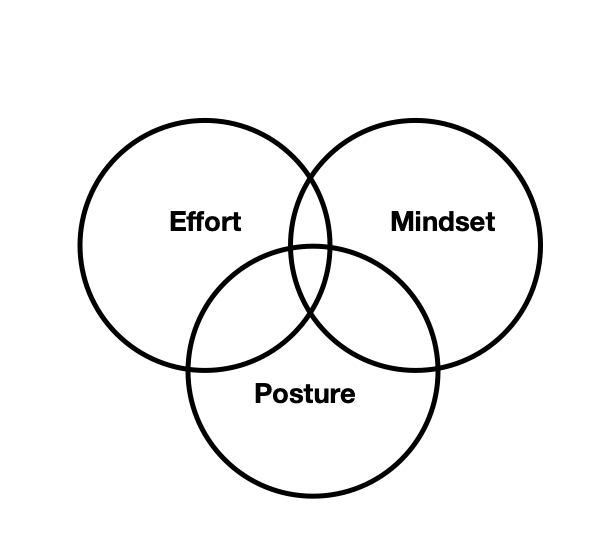
There are three outputs I intend to personally focus on daily. The amount of effort I put into a moment, the mindset in which I encounter the moment, and the posture I assume at any given moment. It is not a complex toolbox but contains areas of focus that impact how I embrace or collide with real-time events. To provide a bit more depth and dimension, I am defining these concepts as follows:

Effort = exertion, energy, action, attention, focus, force

Mindset = attitude, mood, philosophy, belief, perspective, approach

Posture = pose, presence, stature, position, geography, phase

I have not developed a metric to track each concept yet, but considering creative methods to capture the flow of each output.

What guiding areas of focus support your efforts to create the best rendition of your work?

Dashboards

What information do we need to be tracking? How much data do we need, and at what frequency? How do we balance doing the work with being reflective of the metrics? Do we need a snapshot or a deep dive into the numbers? 

Quarterly reports, guidebooks, heads-up displays, and forecasts are helpful if we know how to apply them to the terrain we encounter. Otherwise, it is easy to steer the enterprise onto an abandoned dead-end road. Many of us have made ‘great time’ during our travels while headed in the wrong direction.

Amaze vs. Contribute

Some things amaze me. I might be impressed by scrolling social media, navigating a city, or walking in nature. Not all of these moments of wonder add value to my journey. Some are worth a glance, but few are worth double-clicking on to explore further. How might we assess if our primary motivation is to amaze our audience or contribute to their odyssey? Are we curating moments for Klout or customizing a benefit that serves those who follow?

Meeting?

Why do we gather, and when should we assemble? According to a Harvard Business Review article, there is a flow chart to review before calling a meeting. Dan Martell proposes the 1-3-1 method of decision-making for a one-on-one meeting. Simon Sinek has an online course dedicated to meetings. Seth Godin breaks down different types of meetings.

I rarely get excited to schedule a meeting. However, when it has a purpose that intersects with my purpose and is facilitated to elevate our best ideas and insights, I can leave feeling better about the organization than when I arrived. Leading a meeting is a skill. Anyone can call a meeting, but few can conduct a great session.

How might we ensure the best person on our team is leading our meetings, even when they may not have the title (or seniority)?

Trail Name

Trail names are popular among thru and ultra hikers, a chance to assume a new identity or have a nickname bestowed on you by other hikers based on a personal characteristic. I met numerous hikers on the Colorado Trail last summer, and most I knew only by their trail name. These nicknames worked seamlessly in the wilderness but might need some explanation if shouted out in the middle of an airport terminal. A confluence point for all of us was that we shared a purpose and journey. Even an in-camp conversation with a hiker headed in the other direction provided a chance to exchange names, even though we would continuously move in opposite directions for the foreseeable future.

We bestow the equivalent of trail names on professional colleagues. Some nicknames are advanced affectionately, some have no known origin story, some represent a person’s flaws, and some names are self-appointed. They reflect a sense of connection and shared journey.

One of the ways to determine who is in your clan is to see who you know by nickname or title. We might be uncertain about how far our influence reaches. Those we know by nickname might be a good delineation. And if we should know somebody better, sharing our trail name might help find a point of connection.

Payout or Annuity

Do you take the payout or defer it for another day? Do you elect the over-scheduled board member or wait until they can focus on your cause? Do you ask the donor for a campaign gift even when they suggest they can do something more significant in a few years? Do you launch the new program with numerous gaps or continue assembling a more complete team before activating? Do you grab headlines with a sensational claim or send a press release after you have completed a remarkable level of service?

Each scenario above is too vague to answer definitively but represents generative questions. They are worth pondering; each serves as a proxy for the real-time decisions we need to make. Trying out a new tactic during a training session offers immediate feedback and is more effective than waiting for a competition. If we delay until the race to deploy a new strategy, our results are often hampered by our lack of preparation. Train today so our capabilities are evident, and we are prepared when the spotlight focuses on our enterprise.

Static Things that Change

How can an ancient archeological site that appears static embody change? With research, we might find black-and-white photographs of the locality from a century ago. Despite weathering, it looms untouched. What alters is our interpretation of the relic. Upon ‘discovery,’ it might have been viewed as the height of ancient civilization and the leading manifestation of an architectural style. Then, the narrative is amended. Perhaps another archaeological site was discovered underneath, complicating the story of who settled here and why one culture built over the remains of another. The legacy associated with the scene fractures and the lived history of different peoples are considered. Scholars present papers on the progress and regression associated with the people who constructed and lived on site. Historical interpretation signs are altered to reflect the language of the current times. The structure remains static, but the narrative evolves.

What organizational decisions and landmarks require reinterpretation in your enterprise? What have you inherited that may appear static but is layered with the need for further conversations. What have we assumed was settled only to be resurfaced?