Planning

Following

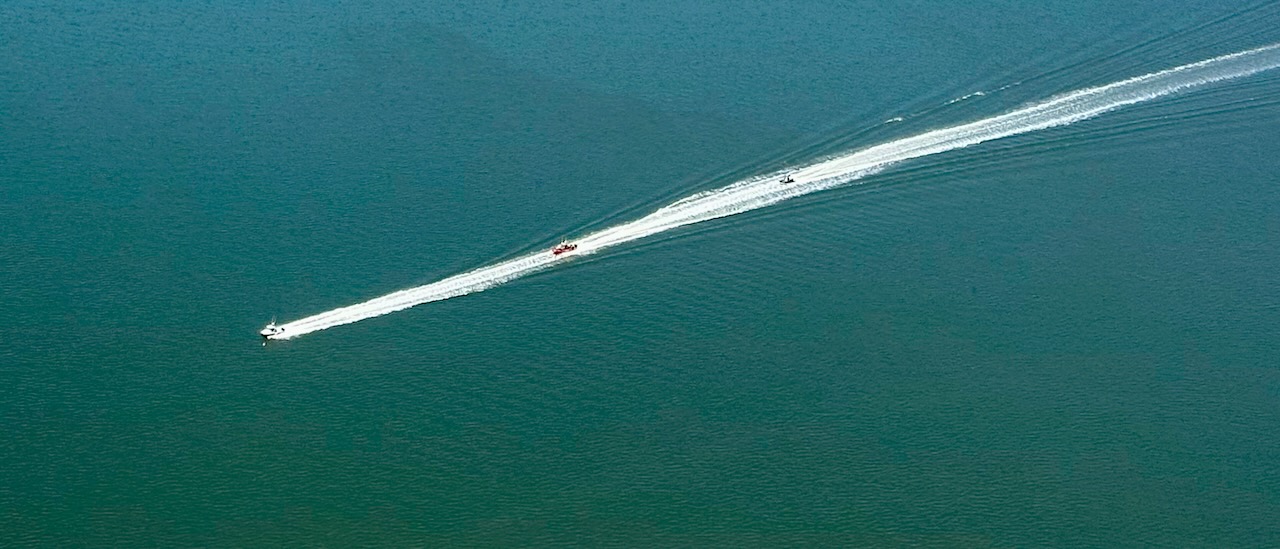
Three boats in a row, the latter two following the wake of the first. Who has the most responsibility in this scenario? Do the second and third boats leverage some leadership to the lead boat? Do they each maintain equal accountability for their autonomy?

It is convenient to allow those we follow to set the course? We can lapse into a daze and miss key landmarks, junctions, possible threats, and options.  It does save us energy and resources to turn over leadership to those who take the point.

How might we be more intentional about when we lead and when we follow?  Who might we remain flexible to break off from the pack when it serves our best interest or the navigation requires individual decision-making?

Boundaries and Functionality

The FAA established Air Route Traffic Control Centers (ARTCC). They where not all created at once but they attempt to reflect the volume of flights and major airports that exist within each region. As general aviation pilots or plane spotting enthusiast we might have some depth of understanding as to why certain border exists. However, the genral public probably does not see the immediate rational. When in-flight, it is not obvious that our commercial flight has been handed off from one center to another (unless the air traffic control audio is made available). We assume this works like a trail being routed onto the right tracks when it leaves a large train station.

What systems in our enterprise works like the ARTCC? Which need explanation to those we serve and which ones operate in the background and provide social benefit without being highlighted?

Together or Separate

When we share a Magnetic North (purpose, vision, mission, and values), it is easier to decide on behalf of the group if we arrive at an intersection first. If we are unclear about our compass, we will likely wait for the group to assemble before proceeding. If we consider generative questions when our environment is stable, we get clarity on where the boundaries exist for our team. We can forerun future events if we deliberate about unique situations our peers encounter. A culture of curiosity allows us to focus on the work that matters and guides our reaction when we find ourselves lost in the wilderness.

We cannot always be together, call a meeting, or wait for an answer. Periodically, we must act for the whole. A sense of shared purpose and a calibrated compass enables us to navigate, even in unfamiliar terrain.

Colossal or Fly By Scale

Speed changes our sense of scale. Flying in a commercial aircraft over the landscape at 30,000 feet, we can take a peak out the window, then sip on a drink for fifteen minutes, and upon looking out the window again, the geography changes. However, shouldering a backpack and tugging on hiking boots, traversing the terrain becomes a colossal undertaking, perhaps taking weeks to cover.

How might we recognize that the speed at which we move changes the sense of scale? How might we account for the delta between a road trip on an interstate and a thru-hiker on the Continental Divide Trail? How might we understand the scale facing those that we serve?

Opportunities to Feel Nervous

What commitment have you made that generated a nervous feeling? Was it the uncertainty, the scale of the endeavor, the unknown result, the inability to de-commit?

Feeling nervous can be viewed as a privilege in some situations. We put ourselves on the starting line of a race by choice. However, it can also be generated by external forces, a deadline, a demand placed on us, or unfortunate circumstances. Nervousness heightens our senses, and we must react. We might feel isolated, as if on an island with insufficient space to gather resources and respond. Our mindset could be our most significant advantage or disadvantage at this moment. How we frame nervousness has a profound impact on how we act? Seeing a competition as a celebration of all the training we endured has a different feel than seeing a race as an event filled with moments of possible failure.

How might we embrace the privilege of nervousness (when appropriate) and celebrate the opportunity to act? How might we recognize that we may not always have the chance to feel nervous and this is a unique moment?

You Are Seen

A relative’s daughter transferred to a new High School this year. She is joining as ‘the new student,’ trying to navigate the complexities of teenage networks. After her first day, friends from her previous High School texted her to ask how the day had gone and about her experience. To me, this is the best of humanity, looking out for others as we aspire to be forces for good.

A recurring question from social sector organizations is, ‘Why have a strategic plan?’ Their typical barriers list include time, resources, frustration with the process, lack of engagement, failure of past plans, etc. I respond with counter-points and shifting mindset possibilities. However, I changed my focus the other day, advocating that these plans are for those we serve. They represent a hat tip, a shout-out, and an ‘I see you’ text to our community. It is a promise that we value their presence, and here are our best ideas to serve each of them. It is an opportunity to offer a point of confluence, a shared journey forward, but it only works if they have a seat in the boat to help us paddle around the next bend.

What if your next plan adopted the perspective of a shout-out to those you serve, reminding them of the miles traveled together and the opportunity to craft a narrative for what will come? What if it is as simple as texting your fans, ‘We see you. Thank you for being with us. Will you join us as we strive onwards?’

Predicting the Future- Poorly

If we can predict the future, why did we schedule the gala performance on the night of an enormous summer thunderstorm?  

How might we recognize that we cannot predict the weather and, therefore, probably cannot anticipate other critical future events? Perhaps we should leave space in our planning to adjust and reroute.

Changing Topography

The power of generative conversation is similar to playing in a sandbox. We can build, alter, and discard ideas without worrying about the constraints of reality. Like the Topography Sandbox, we can quickly alter the terrain and consider new possibilities. How might we make room for generative conversation in our next meeting?