 Where do you go to get your information? Does the source matter? If I am asking for directions are there a number of uniquely qualified sources? If I am asking for your personal opinion is there anyone you would allow to serve as your proxy? Some information is abundant and already cataloged. Personalized recommendations and opinions come from an individual source (or somebody very close and whom we can trust). We do not need to recreate Wikipedia or Google within our limited infrastructure. What we do need is to curate and care deeply about our perspective, the meaning we have drawn out of the world. People will seek out your insights because they are limited editions and offered only by you. Your genuine ideas matters, even if they are confirmation of that which is already known. Be prepared to share. Google will always lag behind real-time interactions.
Author: whatifconcepts
A Lesson from One Club
 Golfer Bubba Watson recently played a round using one golf club, foregoing the 13 other clubs allowed in his bag during competition. He said the experience helped him develop his skills and also changed the routine. What are ways to break-up the routine of meetings within organization. Here are some ideas:
- Off-site meetings (new location, travel related, even a different room)
- Invite guest speaker
- Meet with another board (partnering organization, similar size different sector, mentoring organization)
- Active experience (river rafting, hike, bowling, scavenger hunt)
- Attend conference
- Hire facilitator
- Webinar or online class
- Group read- read the same book/article/packet in advance
- Generative thinking agenda
- Scenarios from a hat (hat tip to Whose Line is it Anyway)- select random scenarios for brainstorming sessions
- Listening tour
- Online poll (for board, membership, community)
- Show and Tell- bring one idea from another enterprise that may benefit organization/operations
- Speed Networking- one-on-one sessions for board and staff members to get to know each other
- Change seating arrangement (new layout, standing only, bean bags, etc)
- Invite past board members back for update and advice
- Start meeting with a mini-TED Talk from one board/staff member
- Spark- reflect on how organizations best ideas were generated
- Graphic facilitation- illustrate the organization’s current status and future potential graphically
Suspicious Minds

Why do many of us look at the “you are a winner” banner ad with such suspicion and disdain? Many of us see these pop-up advertisements as not only annoying but as possibly the beginning of the meltdown sequence for our device.

Why then are we confused by the lack of engagement when the “donate now” button on our home page stands in the way of telling our story? So many great causes bury their story in order to make room for the contribution channel. Poorly executed, a “donate now” option is a bit like a lobster pot randomly tossed on the ocean floor. Something is bound to walk in but without a strategy it may never be a lobster.

Some of the most compelling enterprises offer an vision of a compelling future. A destination that is relevant to the reader but not easily reached. An organization that demonstrates it is uniquely positioned to undertake the journey builds a foundation of trust. The cause may then offer the community a chance to provide fuel for its quest. The “donate now” button becomes an opportunity to invest in a shared belief not a trap of surprise. The lobster pot donor interaction is transactional the visionary is aspirational. Which model will have the most profound impact on the future of your organization?
Charles Russell’s Letters
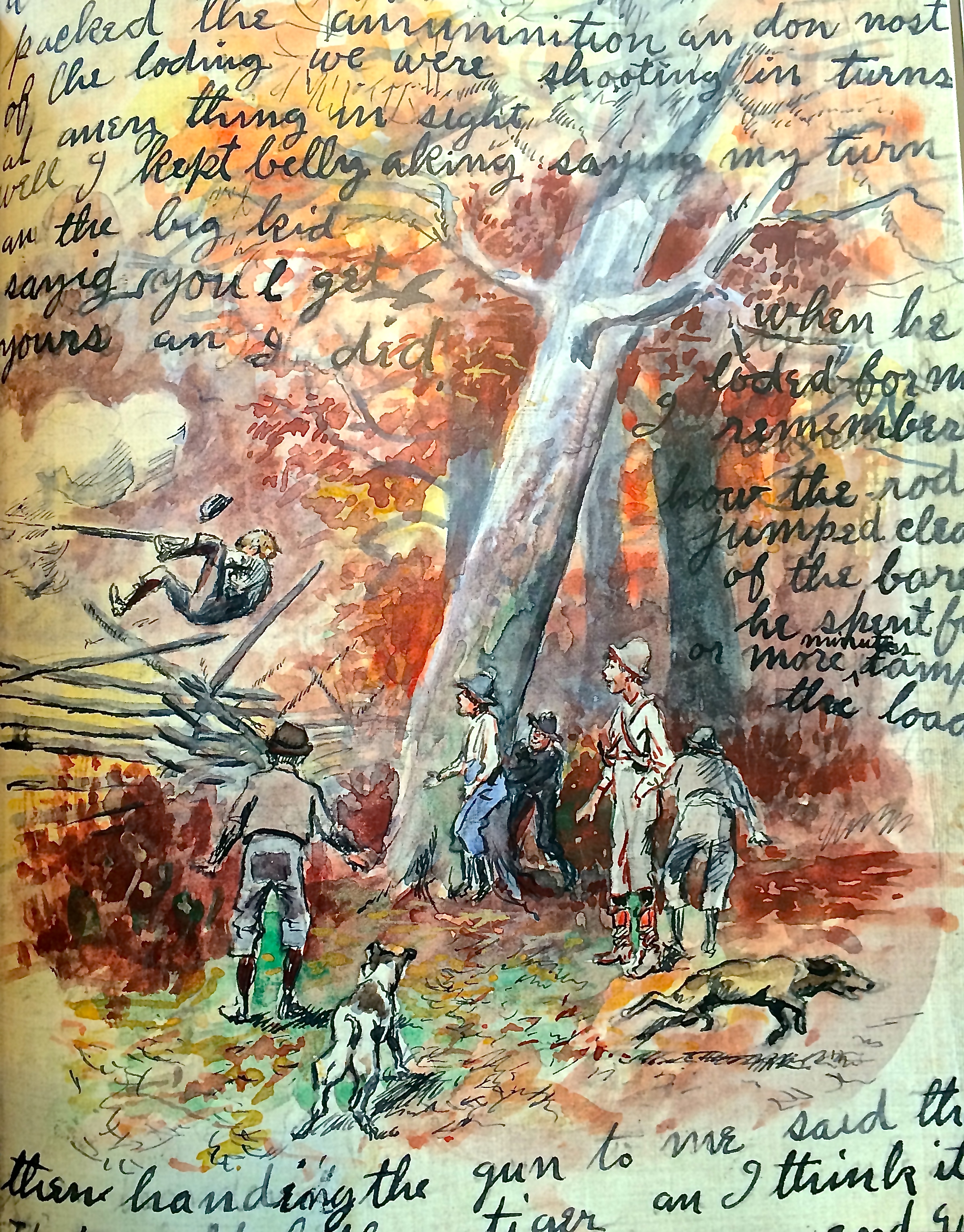 The 100 Best Illustrated Letters of Charles M. Russell is a fascinating book. The letters provide unique insights into the American West in the late-1800’s. What makes the letters remarkable to me are the illustrations Russel added to tell a richer and more colorful story. The drawings themselves illuminate a deep, focused experience. Russell’s work is a great reminder that when we tell our stories the use of images adds exponential value.
Scale
 How do we scale? Collaboration. We cannot do it alone. The destination we seek requires assistance from others. As Simon Sinek reminds us, if we were great at everything we would have no need for others. We scale by taking our greatness and finding others who are uniquely positioned to amplify our strengths by employing their super powers. The opportunity that exists in front of us is the result of those who went before and collaborated.
Change

John Kotter outlines an eight-step hierarchy to create change and build a new culture. If we isolate the first three steps, it is often the starting ground for a strategic initiative. Developing a strategy if there is not a sense of urgency or critical people are missing from the team has less likelihood of maximizing its impact. Just because we think an opportunity or challenge is urgent does not automatically make it so for others. If we have a personal experience that illustrates the opportunity for change, we are much more likely to act.
Relationship or Compliance
 My favorite causes to support with my time, treasure, talent, and touch are the enterprises where I have a genuine relationship with an individual or more who is intimately involved within the organization. I care about them. I want them to have fuel for their journey. We talk about visions and exchange details about our lives, even if they are delivered in synopsis. The organization’s goals are intertwined with the people who represent them so authentically. I am excited to hear their voice and support them even when they have moved on to the next chapter.
The causes that do not resonate with me entirely value transaction and compliance above relationship. They frequently blast communications outlining the burning platform that faces them. Driven by a fundraising goal, social media campaign, last effort to stop change, and anything else that puts their needs superior to those who they intend to cultivate. Their annual report is a form of score keeping, what have you done for us in the past 12-months. My ideas and networks are only valuable to them if they can be quantified in a return on investment metric. The interactions are predictable, stagnate, and forced.
Much is revealed if people see you for who you are and not the form they wish you would take. I may come and go from the inner circle of an enterprise but that does not mean our relationship is diminished. When we stop communicating because I did not participate in the latest transaction or comply with an offer then there is little left to build upon for the future.
Be brave, build relationships that matter.
How to think like a scientist but talk like a truck driver
Net Neutrality can be complicated. I was struggling to fully understand the ramifications of the currently proposed FCC legislation. I spent a couple minutes watching ViHart’s video and was persuaded to act. When complex ideas are presented in a meaningful way that are easy to use we empower those that are inspired to act. According to John Kotter if we wish to affect change, we need to create a sense of urgency, build a coalition, and present a compelling vision. If all of this can be embedded into a narrative that intersects with our own world view, we are liberated from a sense of fear and the unknown.
What is your edge?

Seth Godin posted about the concept of edgecraft a few weeks ago which offered a compelling insight into embracing that which makes us different. Along Seth’s philosophy, Jo DeBolt from La Piana Consulting asked an intriguing question today at the ED Sessions 2.0 in Boise, Idaho.
What is your edge? How are you remarkably excellent?
Defining our edge clearly underscores how well we understand ourselves and the space we occupy. Trying to be remarkable in a crowd is much like trying to identify stars in the night sky. A few are remarkable because we understand their place in relationship to other night but they also dominate their location.
What is your edge?
Authentic Sales
When you believe, you act.
 What-if-concepts