Innovative Concepts

For Your Remarkable Journey

Honored to present at the ClearRock Capital Conference on the topic of “Edgecraft” this week.  The gathering offers an opportunity to share resources that I find remarkable and I hope will be of service and create value to your journey to the edge.

Seth Godin’s ‘Edgecraft‘ blog post

John Kotter’s leading change theory

Scenic Hudson’s gala honoring its critical partnering organizations

Jia Jang World Domination talk on the power of rejection

Crash Course with John and Hank Green.  It is free and highly engaging.

Teton Valley Ranch Camp’s search for a new home

Charity Water’s Instagram account setting a high level of engagement

The $100 Startup innovator’s guide by Chris Guillebeau to invest in yourself

Khan Academy  flipping the classroom where content is learned at home and mastery takes place in the classroom

Duolingo’s creator Luis von Ahn online scale collaboration TEDx talk.  Learning a language adds value and provides a remarkable service

Holderness School’s residential life project creates a new definition of community and leadership

Generative Thinking sample questions.  What if we gave ourselves permission to embrace ambiguity and our identity?

Decisive (the book) Resource Page with Chip and Dan Heath.  Paving a new way for decision-makers.

The Present changing time and art

Howard Hallis, The Picture of Everything


Do You Need a New Question?

IMG_6444Do you need a path to follow in order to have maximum impact?  Are you trying to obtain top speed and the highest level of efficiency regardless of the direction?  What are you uniquely positioned to offer your community?  If you retraced your steps, would it add value or do you require a new route every time out?  What opportunity if it appeared would make you change course?  What assumption is holding you back?  How do you know?  If you could move the frame what part of your world would you place in the center?  What would you leave out?

We ask generative questions constantly but do we give ourselves permission to explore the answers?  To wrestle with the abstract?  Seth Godin encourages us to pick ourselves.  Chris Brogan reminds us that nobody is going to give us permission, permission was granted long ago for each of us.

What is the most important question you need to ask? 

Pilot Boat

IMG_9565

If you did not have to self-discover the best route all the time but could rely on a guide, would you change your destination?  Often, we avoid the rocky coastline because the consequences of failure are too high.  However, there are individuals who have local knowledge and are glad to join your enterprise for a short period to help navigate.  When we ask for specific directions we may be amazed at what arrives.

Lag

Is information lag causing challenges for your enterprise?  Social sector organizations often rely on their Annual Report to summarize a year’s worth of success but some information is already over 300-days old.  Quarterly investment reports provide insights to market trends that may have been relevant two-months ago.  Sports talk shows debate the past weekend games with the certainty of a poker player competing against an opponent who tips their hand.  We reboot our devices when the audio and visual imagine are mere fractions of a second out of synch.  We hang-up and restart conference calls when the audio has an echo or delay.  We consider passing another vehicle that is not moving with the flow of traffic.

Lag gets attention.  It can inspire (a day in the wilderness with no technology) or infuriate (slow airline check-in kiosk when running late for a flight).  Lag can be powerful.  Historical events come into focus over time, Impressionist painter’s work is now admired more fervently, and scientific trends can be reinforced with additional data points over time.  Lag can be costly.  Not having the real-time information as the other decision-makers, soliciting for a contribution with anecdotes from prior years, or asking for help one step too late.

Employ lag to your benefit, instead of relying on tradition to dictate its application.

Flipping “No”

IMG_9327We cannot be all things to all people.  However, our values can be evident in all our interactions.  Seth Godin recently wrote about using our words to be a positive force.  We can be remarkable simply by flipping our message from negative to the positive.  There are enough “No Parking” signs in the world that we are selectively blind to their existence.  Changing the message can make for memorable results.  Finding a positive way to communicate develops trust and loyalty, even when we are asking others to refrain from an activity they enjoy.

Screen Shot 2014-04-28 at 10.19.56 AM

Information from You

IMG_5910Where do you go to get your information?  Does the source matter?  If I am asking for directions are there a number of uniquely qualified sources?  If I am asking for your personal opinion is there anyone you would allow to serve as your proxy?  Some information is abundant and already cataloged.  Personalized recommendations and opinions come from an individual source (or somebody very close and whom we can trust).  We do not need to recreate Wikipedia or Google within our limited infrastructure.  What we do need is to curate and care deeply about our perspective, the meaning we have drawn out of the world.  People will seek out your insights because they are limited editions and offered only by you.  Your genuine ideas matters, even if they are confirmation of that which is already known.  Be prepared to share.  Google will always lag behind real-time interactions.

A Lesson from One Club

IMG_5903Golfer Bubba Watson recently played a round using one golf club, foregoing the 13 other clubs allowed in his bag during competition. He said the experience helped him develop his skills and also changed the routine.  What are ways to break-up the routine of meetings within organization.  Here are some ideas:

  • Off-site meetings (new location, travel related, even a different room)
  • Invite guest speaker
  • Meet with another board (partnering organization, similar size different sector, mentoring organization)
  • Active experience (river rafting, hike, bowling, scavenger hunt)
  • Attend conference
  • Hire facilitator
  • Webinar or online class
  • Group read- read the same book/article/packet in advance
  • Generative thinking agenda
  • Scenarios from a hat (hat tip to Whose Line is it Anyway)- select random scenarios for brainstorming sessions
  • Listening tour
  • Online poll (for board, membership, community)
  • Show and Tell- bring one idea from another enterprise that may benefit organization/operations
  • Speed Networking- one-on-one sessions for board and staff members to get to know each other
  • Change seating arrangement (new layout, standing only, bean bags, etc)
  • Invite past board members back for update and advice
  • Start meeting with a mini-TED Talk from one board/staff member
  • Spark- reflect on how organizations best ideas were generated
  • Graphic facilitation- illustrate the organization’s current status and future potential graphically


Suspicious Minds

Why do many of us look at the “you are a winner” banner ad with such suspicion and disdain?  Many of us see these pop-up advertisements as not only annoying but as possibly the beginning of the meltdown sequence for our device.

Why then are we confused by the lack of engagement when the “donate now” button on our home page stands in the way of telling our story?  So many great causes bury their story in order to make room for the contribution channel.  Poorly executed, a “donate now” option is a bit like a lobster pot randomly tossed on the ocean floor.  Something is bound to walk in but without a strategy it may never be a lobster.

Some of the most compelling enterprises offer an vision of a compelling future.  A destination that is relevant to the reader but not easily reached.  An organization that demonstrates it is uniquely positioned to undertake the journey builds a foundation of trust.  The cause may then offer the community a chance to provide fuel for its quest.  The “donate now” button becomes an opportunity to invest in a shared belief not a trap of surprise.  The lobster pot donor interaction is transactional the visionary is aspirational.  Which model will have the most profound impact on the future of your organization?

Charles Russell’s Letters

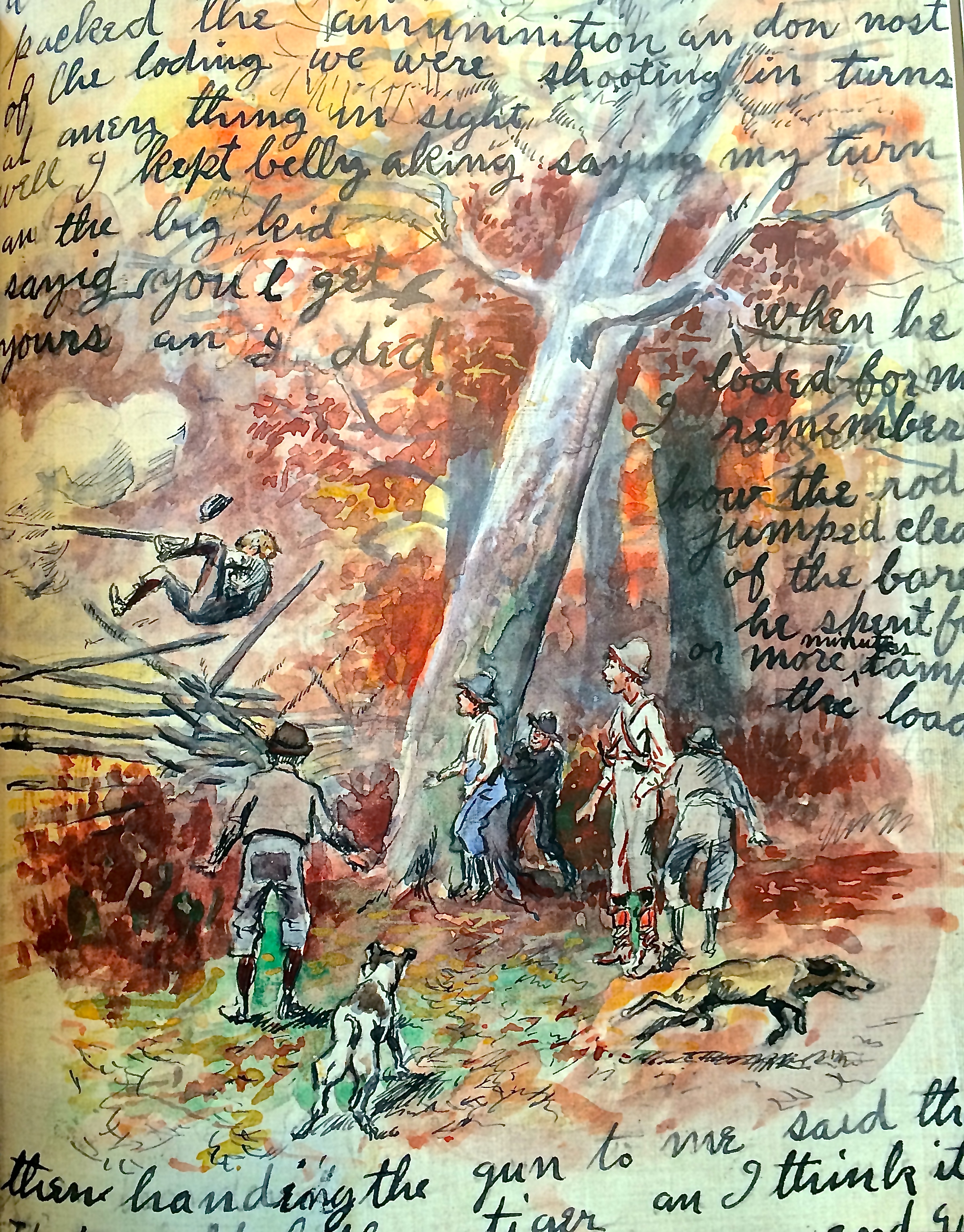
IMG_6091The 100 Best Illustrated Letters of Charles M. Russell is a fascinating book.  The letters provide unique insights into the American West in the late-1800’s.  What makes the letters remarkable to me are the illustrations Russel added to tell a richer and more colorful story.  The drawings themselves illuminate a deep, focused experience.  Russell’s work is a great reminder that when we tell our stories the use of images adds exponential value.

Scale

IMG_6076How do we scale?  Collaboration.  We cannot do it alone.  The destination we seek requires assistance from others.  As Simon Sinek reminds us, if we were great at everything we would have no need for others.  We scale by taking our greatness and finding others who are uniquely positioned to amplify our strengths by employing their super powers.  The opportunity that exists in front of us is the result of those who went before and collaborated.